Category: Blog

PITSS.CON Q&A APP


Back to Home

Legacy Modernization
Oracle Forms
Oracle APEX
Digital Transformation

Ask, Learn, Connect: Your Q&A Hub for PITSS,

Oracle APEX, and Oracle Forms Modernization

In many Oracle APEX and application modernization projects, recurring questions often arise:
Which architecture is most suitable? How can processes be modernized efficiently? What challenges occur in real-world implementations?

In many Oracle APEX and application modernization projects, recurring questions often arise:
Which architecture is most suitable? How can processes be modernized efficiently? What challenges occur in real-world implementations?

To address these questions in a structured way, the PITSS.CON Q&A APP was developed. The application serves as a central platform where users can post questions, share answers, and exchange experiences related to APEX and modernization projects.

The app is also a prime example of how Oracle APEX can be used to quickly build modern, web-based business applications that are accessible on any device and simplify access to complex data and processes.

Who is the PITSS.CON Q&A APP for?

The PITSS.CON Q&A APP is designed for anyone involved with Oracle Forms/Reports, APEX, legacy applications, application modernization, process optimization, application transparency, or enterprise systems.

IT Decision-Makers

CIOs, IT managers, and architects can gain insight into typical challenges in modernization projects and see what questions other organizations are asking.

Developers and APEX Specialists

APEX developers can use the platform to discuss technical questions, share best practices, and learn new approaches.

Companies with Legacy Systems

Organizations looking to modernize existing applications – such as Oracle Forms systems – can discover common challenges and practical solutions.

Project Teams in Modernization Initiatives

Teams actively migrating or upgrading systems benefit from a structured repository of relevant questions and answers.

What the PITSS.CON Q&A APP offers?

The PITSS.CON Q&A APP provides a simple and intuitive way to gather and exchange knowledge.

  • Centralized Question Collection

Users can post questions about APEX, modernization, or architecture.

  • Structured Answers

Other participants or experts can answer, contributing their insights and experiences.

  • Knowledge Platform for Modernization Projects

Over time, the app builds a growing repository of typical challenges and proven solutions.

  • Web-Based Access

As an APEX application, it runs directly in the browser and is fully responsive – no local installation required.

What the PITSS.CON Q&A APP Can Do for You?

The PITSS.CON Q&A APP delivers multiple advantages for companies and developers alike:

Knowledge Sharing

The platform encourages the exchange of experiences and best practices between experts and users.

Faster Problem Solving

Existing answers and discussions help teams resolve common challenges more quickly.

Insight Into Frequent Challenges

Organizations can immediately see which issues are common across the industry – for example, during migration to APEX.

Community-Driven Approach

The app creates a collaborative environment where knowledge is continuously expanded and refined.

Showcases Modern APEX Applications

At the same time, it demonstrates how Oracle APEX can be used to develop modern web apps that are responsive, secure, and database-driven.

Conclusion

The PITSS.CON Q&A APP is more than just a Q&A platform. It serves as a central hub for anyone involved with Oracle APEX and application modernization.

By combining knowledge sharing, real-world experience, and modern web technology, the app helps organizations understand challenges faster and implement solutions more efficiently.

PITSS.CON Q&A APP

Continue reading

Why modernization


Back to Home

Legacy Modernization
Oracle Forms
Enterprise IT
Digital Transformation

Why Modernizing Legacy Applications

is Business-Critical

Many core applications were built when business models were far less dynamic. Today they create high risks and block strategy. Modernization is not an IT project — it’s a strategic lever.


PITSS Editorial Team


March 2, 2026


8 min read

Why Renewing Legacy Applications is Business-Critical

Many of our core applications were built at a time when business models, processes, and customer requirements were far less dynamic. Today, these systems generate high operational risks, prevent scaling, and hold back strategic initiatives. Modernization is therefore not primarily an IT project — it is a strategic business lever.

The Core Argument

Modernizing legacy applications is not an optional IT upgrade — it’s a strategic business enabler to increase efficiency, reduce risks, and position the company for the future.

1 Accelerating Innovation & Time-to-Market

Monolithic legacy applications make changes extremely difficult. New features, digital services, or process changes can only be implemented with enormous effort.

Modern, modular architectures enable rapid responses to market demands — shipping new features in days instead of months.

2 Higher Data Quality & Better Decision-Making

Legacy systems create data silos and make analytics and AI-based evaluations difficult or impossible.

A modern data foundation enables better customer insights, faster decisions, and unlocks the potential of AI-driven automation.

3 Improved User & Customer Experience

Outdated interfaces reduce productivity and customer satisfaction, driving up training costs and leading to widespread workarounds.

New applications increase efficiency, adoption, and service quality — and give employees tools they actually want to use.

4 Reducing Operational Risks & Maintenance Costs

Legacy systems are built on outdated technologies and specialized knowledge that is increasingly hard to find. Outages or security vulnerabilities can immediately impact business operations. Furthermore, many business processes are still held up by manual workarounds or poorly integrated third-party systems — commonly known as Shadow IT.

Hidden Risk

Shadow IT — undocumented manual workarounds and ad-hoc integrations — can silently undermine compliance, data integrity, and business continuity. Modernization brings these into the light.

Modernization increases stability, supportability, and compliance. Through automation, cloud readiness, and modern platforms, long-term costs decrease significantly.

5 Future-Proof Scalability

Growth or new business models hit hard technical limits in old systems. Every expansion becomes an engineering struggle rather than a business opportunity.

Modern applications scale on demand and support international expansion without architectural rewrites.


How to Successfully Modernize a Legacy Application?

The key tool is the Process–Application Fit Matrix. It helps assess how well a legacy application supports your current business processes along two dimensions.

Dimension 1
Business Value

How important is this process to the business?

Dimension 2
Application Fit

How well does the legacy system support this process?

The Basic Process–Application Fit Matrix

Application Fit ↓  /  Business Value → High Business Value Low Business Value
Good Fit ✓ Stable & Worth Keeping Non-critical — can stay
Weak Fit ⚡ Strategic Modernization Need Opportunistic Modernization

Evaluation Criteria

Business Value
  • Process is business-critical
  • Process generates revenue
  • Regulation or compliance-relevant
  • Strongly customer-facing
  • Differentiates from competitors
Application Fit
  • Functional coverage
  • Stability & Performance
  • Changeability (Time-to-Change)
  • Integration capability (APIs)
  • Security & Compliance
  • Usability & automation level
💡 An Important Addition

In highly grown applications, a third value appears in practice: “Obsolete” for Business Value, and “Non-existent” for Application Fit. Obsolete processes are still in the code but no longer lived. Non-existent fit means the digital capability simply doesn’t exist yet and must be built from scratch.

The Extended Matrix (Recommended)

Business Value / App Fit → Obsolete Medium High
High Remove “Reskinning” — homogeneous architecture Focus on Maintainability, Enhancement & Performance
Medium Remove Can standard software take over? Find the diamonds — create a Redesign
Non-existent Can standard software take over? New development with deep data model integration

Real-World Examples

Application Fit can address different components within the same software. Click each example to explore the diagnosis and goal:

“Order entry works fairly well, but the user experience is poor.”

The data model and implemented logic — such as validations and calculations — are correct. However, it is difficult for users to efficiently handle the standard case.

Data model and business logic are solid, but the interface is the bottleneck.
Goal: Lean User Interface and significantly better User Experience.
“Goods outbounding is inefficient, even though it is easy to use.”

The UI works fine and all data is available, but the algorithm calculating the outbounding is error-prone, outdated, and must be reworked.

UI fits, data fits — the business logic itself is the problem.
Goal: Revision and optimization of the Business Logic.
“In goods receiving, customer RMA assignments are missing.”

UI and logic for goods receiving are fine. Goods are received and stored, but the data model is missing the automated assignment to the customer’s goods announcement.

UI and logic are sound — the data model must be extended.
Goal: Anchor the assignment in the data model and implement it in the application layer.

How PITSS.CON ProFind Makes This Possible

In monolithic legacy applications, mapping software artifacts to an individual business process is not always easy — or even possible. The examples above show that the assessment can relate to different components simultaneously, and it is sufficiently complex to check how everything connects across the entire application.

You can only trust the code and the way users actually interact with it.

PITSS.CON is a software repository that examines and consolidates the implementation of the legacy application with its actual runtime usage by users, batch processes, and interfaces.

PITSS has been awarded twice by the BMBF for its unique approach of connecting static code with live runtime data.

Defined target processes can be efficiently captured and compared against actual usage patterns — step by step generating the valuable input your Process-Application Fit Matrix needs. Once assessed, PITSS.CON helps identify all artifacts belonging to each matrix segment and prepares them for modernization.

The PITSS.CON Promise

All of this — covering the data model, business logic, and every individual UI — without lengthy interviews, endless manual documentation, source code misinterpretation, or unnecessary burden on your business users.

With PITSS.CON, you can modernize your legacy application in a step-by-step, risk-free, cost- and benefit-optimized project — guided at every stage by the real picture of how your system is used.

Ready to assess your legacy application?

Let PITSS.CON ProFind map your codebase, usage patterns, and business processes — and build your modernization roadmap based on facts.

Continue reading

Blog Article – Biggest Challenge in Modernization

Back to Home  

 Webinar Poll Results

Oracle APEX Oracle Forms Modernization Survey Enterprise IT

Why Integration Is the Biggest Challenge in Oracle Forms Modernization

Live poll results from our webinar “APEX at Scale: Your Blueprint for Modernizing Oracle Forms” — featuring insights from Simon Hunt, Head of Product Management at Oracle APEX.

PITSS Editorial Team March 13, 2026 7 min read

Valuable Insights from the Webinar

Modernizing Oracle Forms applications and moving them to Oracle APEX raises many strategic and technical questions — but which challenges are organizations actually facing in practice?

To explore this, we asked the participants of our recent webinar “APEX at Scale: Your Blueprint for Modernizing Oracle Forms” about their biggest hurdles and priorities. The session featured insights from Simon Hunt, Head of Product Management – Oracle APEX, who shared valuable perspectives on modernization strategies and the evolution of APEX.

Survey Scale

With more than 200 registrations, these poll results provide a statistically meaningful snapshot of the challenges enterprises are currently navigating in Oracle Forms to APEX modernization projects.

Integration: The #1 Challenge in Enterprise APEX Adoption

As enterprises deploy an increasing number of specialized applications to support diverse tasks and business processes, integration has emerged as the top concern for IT teams.

POLL 1 OF 2

Integration: The #1 Challenge in Enterprise APEX Adoption

As enterprises deploy an increasing number of specialized applications to support diverse tasks and business processes, integration has emerged as the top concern for IT teams.

Integrations

48%

Library concepts

38%

Performance

33%

Security

31%

Large developer teams

30%

None

14%

Others

8%

This highlights a growing need to ensure that all components of an organization’s software ecosystem can communicate seamlessly — and that modernization is seen as an ecosystem-wide undertaking, not just an application swap.

Why Integration Matters: The API-First Gap

In many organically grown system landscapes, an API-first strategy is often missing. Interfaces and services have evolved in a fragmented and inconsistent manner — each application a silo unto itself.

Modernization offers a unique opportunity to realign the entire architecture around communication patterns and data flows — building a foundation for robust, maintainable, and scalable applications.

From a technology standpoint, Oracle APEX provides a comprehensive toolset for integration. It allows developers to efficiently consume REST services and expose new REST endpoints. At the same time, the full power of the Oracle Database ecosystem — including Oracle Integration Cloud — remains fully accessible. With APEX delivering a pure HTML5/CSS/JavaScript interface, UI-level integrations can leverage modern web standards.

PITSS.CON’s Role in the Integration Journey

During the modernization of legacy Oracle Forms applications, PITSS.CON plays a critical role. It ensures that essential artifacts — such as complex business logic or data provisioning components — can be exposed as RESTful API services.

PITSS.CON’s end-to-end dependency management across applications lays the groundwork for a consistent and maintainable API catalog — helping enterprises streamline integrations and improve overall system coherence.

Twice awarded by the BMBF for its unique approach of connecting static code with live runtime data.

The Bigger Picture

Modernizing enterprise applications isn’t just about updating technology — it’s about redefining how applications interact, ensuring data flows smoothly, and empowering businesses to fully leverage their software ecosystem. Integration is not just an option — it’s a necessity.

Poll 2: The Two Biggest Obstacles in Forms → APEX

The survey results clearly highlight two obstacles that stand above the rest when organizations move their Oracle Forms applications to Oracle APEX.

POLL 2 OF 2

The Two Biggest Obstacles in Forms → APEX

The survey results clearly highlight two obstacles that stand above the rest when organizations move their Oracle Forms applications to Oracle APEX.

How to avoid 1:1 migration

43%

How to improve UX

33%

Transaction handling

30%

Function Keys

28%

Enter-Query Mode

22%

Client-Access

16%

Others

12%

These two findings reflect the core complexity of modernization projects: organizations are not simply looking for a technical migration path, but for a way to rethink how their applications work in a modern architecture.

43% Avoiding the 1:1 Migration Trap

The most frequently mentioned challenge is avoiding a 1:1 migration. Replicating an existing Oracle Forms application exactly as it is in APEX may seem like the fastest approach — but this strategy often reproduces the same limitations that already exist in the legacy system.

Instead of taking advantage of modern capabilities, organizations risk transferring outdated user interfaces, overloaded screens, and inefficient process flows directly into a new technology stack.

The Classic Dilemma

Organizations face a choice between a “quick and dirty” migration on one side and an exhausting full rewrite on the other. Fortunately, there is a pragmatic middle path — and the poll results show that teams are actively seeking it.

Organizations can preserve their investment in application components that still deliver value — while selectively renewing the parts that are outdated or no longer aligned with modern requirements.

30% Transaction Handling in a Modern Architecture

The second most significant challenge is transaction handling. Oracle Forms applications often manage transactions in ways that are tightly coupled to the application runtime and its stateful interaction model.

When moving to a modern web-based environment like APEX, these mechanisms must be reconsidered. Transaction logic, commit strategies, and process flows may need to be redesigned so that they fit into a more flexible and scalable architecture.

This does not necessarily mean rewriting everything from scratch. In many cases, the underlying business logic and database structures remain technically sound and are worth reusing.

Not Everything in Legacy Applications Is Obsolete

Legacy applications are often perceived as outdated as a whole. However, a closer look typically reveals a more nuanced picture.

Even in older systems, certain elements remain technically solid and continue to deliver value — while other areas clearly require rethinking:

Often worth keeping

Database structures
Core business logic
Proven validation rules

Needs rethinking

Process support may be inefficient
User interfaces are often overloaded
The overall user experience rarely meets modern expectations

Even within the UI layer

Not everything in the UI needs to be discarded. Many validations, messages, and labels still make sense and can be reused instead of being recreated from scratch — reducing both risk and project duration.

A Process-Driven Modernization Approach

To navigate this complexity, organizations need transparency into their existing systems. With its dependency analysis and code quality assessment capabilities, PITSS.CON helps identify which components of an existing application can be effectively reused in a new APEX environment.

This approach enables a clear, process-driven modernization strategy:

01

Analyze

Examine the existing system to understand dependencies and code quality across the full application.

02

Identify

Pinpoint which components in the database and business logic can be effectively reused in a new APEX environment.

03

Focus

Direct modernization efforts exclusively on the areas that genuinely require improvement or replacement.

04

Align

Redesign the application around actual business processes — not around the monolithic structure of the legacy system.

Modernization is not just about replacing the UI with an APEX interface. While redesigning the user experience is the most visible change, the real value lies deeper. By combining reuse of stable components with selective renewal, organizations can:

  • Reshape the APEX user interface
  • Improve process support
  • Modernize application architecture
  • Avoid reimplementing every rule and piece of logic

The Core Insight

This ensures that modernization happens alongside business processes — rather than being constrained by the monolithic structure of the legacy system.

Conclusion: Reuse, Renewal, and the Right Balance

Migrating to APEX should not be treated as a simple technology replacement. The real challenge — and opportunity — lies in finding the right balance between reuse and renewal.

By analyzing existing applications carefully and focusing modernization on the components that matter most, organizations can transform their legacy systems into modern, process-oriented solutions — without losing the value built over years of development.

Webinar Available On-Demand

Want the full insights?

If you missed the live session, you can still request the webinar recording and explore the full discussion — including Simon Hunt’s perspective on APEX modernization strategy.

Request Webinar Recording

Continue reading

PITSS & OCI – a strong statement

PITSS & OCI –
a strong statement

PITSS’ strategy, innovation, scalability,
and global collaboration based on OCI
– Oracle Cloud Infrastructure

Oracle Cloud Infrastructure (OCI) is a foundational element of PITSS’ strategy, enabling innovation, scalability, and global collaboration. By leveraging OCI, PITSS modernizes not only its own operations but also delivers future-ready solutions for its clients.

Cloud technologies have really taken over the way companies and organizations do business in the past decade. In an increasingly global market, companies have increased the reliance on using the cloud to help conduct business on a more global scale. Cloud infrastructure platforms like Amazon AWS, Microsoft Azure, and Oracle Cloud Infrastructure provide such environments to help store companies’ databases and servers securely in the web without needing an on premise server and network closet helping to reduce the costs of running in-house servers.

Over the past several years, PITSS has fully utilized the use of Oracle Cloud Infrastructure (OCI) for everyday work. Since its founding, PITSS has worked with Oracle technologies to help customers upgrade their Oracle Forms applications to the latest releases as well as migrate them to more modern Oracle technologies like Oracle APEX. PITSS has chosen OCI as its preferred cloud platform as it is best suited for running Oracle Databases, Oracle Forms, and APEX applications in the cloud within reasonable costs.

PITSS trust on OCI for Oracle Forms to APEX projects

PITSS has been working on several customer migration and modernization projects using OCI as well as completed Oracle Forms to APEX migration projects using it. With such modernization projects, PITSS has set up Oracle Databases as well as compute instances inside OCI as a means to store the data necessary for these projects. With consultants connecting from around the world in Europe as well as North America and Asia, having all projects run in the cloud allows PITSS to work on projects in a global manner. OCI provides ways to secure customer data securely by protecting data using private subnets and requiring private keys to access such data. With running the database and server instances in the cloud, it has reduced the cost for PITSS to purchase additional hardware to maintain such projects. Having OCI as PITSS’ main platform for customer projects, it has enabled its customers to run cloud-ready-applications such as APEX in their environments.

PITSS benefits from OCI for the PITSS.CON development

  In addition to customer projects, PITSS has also utilized the use of OCI for its in-house development. PITSS continuously works to add new features to its product PITSS.CON along with modernization programs like Forms 2 APEX Modeler, Reports Modeler, and ProFind. PITSS has moved all of its development into the cloud to allow developers to work on the product from around the world. Having the development take place in OCI ensures that the development environments are always available without having to worry about network or electrical issues which possibly could occur at a physical office location. OCI also ensures security by protecting data from potential cyberattacks.

OCI supports AI and PITSS around the globe

In fact, the PITSS branch in the US in Troy, Michigan has even moved all of its operations into the cloud eliminating the need to host servers onsite. When Oracle releases new versions of Oracle Forms & Reports as well as APEX, PITSS uses OCI to create compute instances to test out the new versions as well as perform test installations of PITSS.CON to ensure that it is ready to achieve the customer’s desires for upgrading and modernizing their applications. Having these environments in the cloud allows for the rest of PITSS to be able to connect into the cloud instances to perform these tests as efficiently as possible.

Cloud platforms like OCI have enabled PITSS to conduct business and its projects on a more global scale. With the increasing reliance on cloud technologies as well as the increasing use of AI in everyday work, OCI provides such a platform for PITSS to utilize the latest technologies out there and begin using AI for its work with modernization projects. PITSS continues to adapt to the latest technological trends to find better ways to help out potential customers achieve their migration and modernization needs and desires.

Are you also interested in benefiting from the advantages of OCI and to make your modernization project even more efficient and secure?

Talk to us!

Your Contact

Uta Daniels
Assistant of Sales Management

udaniels@pitss.com

+49 711/914-012-12


Continue reading

Oracle Forms vs APEX – Should I stay or should I go?

Oracle Forms vs APEX –
Should I stay or should I go?

Oracle Forms or APEX?
Or Oracle Forms AND APEX?
The future is APEX!

A post by Günther Stürner

Despite Oracle Forms 14, ORACLE FORMS applications are candidates for transformation. Oracle has not yet said so clearly and publicly. It has been couched in diplomatic terms. But the signs are unmistakable. They are crystal clear.

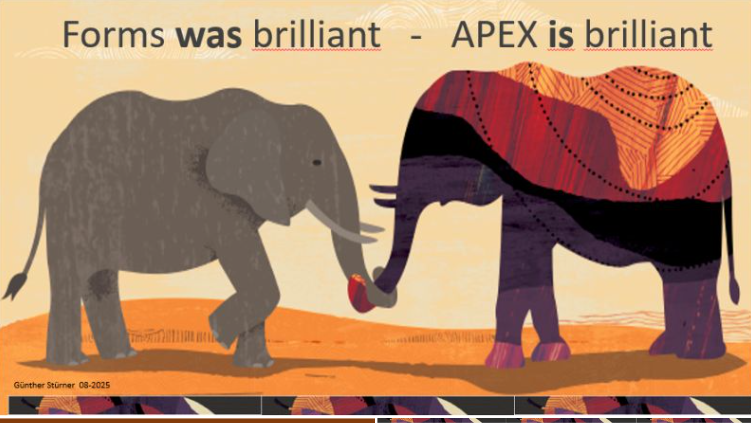
Oracle Forms and APEX elefants - Should I stay or should I go?

“When a technology disappears (Forms & Reports), or at least loses much of its significance, but at the same time there is a successor technology (APEX) that can replace the old technology with relatively little effort and a very high level of security thanks to innovative software tools (PITSS.CON Suite), then that is a blessing.” Günther Stürner

Don’t get left behind…stay ahead of the game

This is a friendly wake-up call to all Oracle Forms and Oracle Reports customers…don’t underestimate the current dynamics in IT! Don’t get left behind…stay ahead of the game!

* Forms upgrade is a MUST 

* Forms upgrade & move to cloud is the perfect step 

* Forms-2-APEX is the gold standard.

Forms-2-APEX migrations and Reports migrations are technically very manageable these days, provided you have the right tools.

Let’s go… but stepwise!

The coexistence of Oracle Forms APPs and APEX APPs is becoming an increasingly important factor in practice. In this variant, existing Forms applications are primarily supplemented by new APEX developments. Cluster by cluster is migrated to APEX and then put into production. During the migration phase, the clusters/modules that have already migrated to APEX are operated together with the existing Forms modules.

So you can relax and choose “I go,” because the seamless transition from Oracle Forms to APEX is the most stress-free form of migration! And you’ll be perfectly positioned for the future!

This cluster approach, which has proven itself in many PITSS projects, makes it possible to operate the entire system as a “hybrid application” during the migration period.

Let’s go together

A blessing for Forms customers, but also a blessing for Oracle. Forms-to-APEX by PITSS.

“Retain your digital assets and reach a new technological level.” Andreas Gaede, CEO PITSS

Take the chance and sign up for a free, one-hour consultation with an expert on Forms-to-APEX here.


Continue reading

Forms 14c is out now

Forms 14c is out now

The perfect time to revitalize your Forms Application
Oracle Forms 14.1.2 was released after a long period of time at the end of last year. Compared to the most previous versions in the past for me this release has the most powerful improvements since the architectural change from pure client/server architecture into a Java based application.

The list of new features and improvements is definitely worth considering
https://www.oracle.com/a/otn/docs/oracleforms-1412-newfeatures.pdf

Your Oracle Forms application with the look of 14c

We as PITSS have seen tons of Forms applications in the past. Many of them look as if they were put into a coma 20 years ago and are now on artificial respiration until a final decision will be made.
This is not necessary!
Forms 14 allows you to revitalize your application into a modern and agile application!

Sure, your application was maintained over decades and perhaps you’re afraid of having a not well documented application which does not support consistent inheritance. Don’t be afraid of that! Oracle Forms still provides Java and C-API which allows you to mass analyse and change your application. If you perhaps like the dynamic sort order of a block, which is a pretty good feature for UX enhancements, the API allows you to rollout that into your entire application.

Product based migration from
Oracle Forms to APEX

Taking into account that your application exists for decades, we could assume that also the former architects and developers of the first breath of your application are close to rest or even left the team. Writing this, the manpower of your team may decrease and for the new team members it’s getting harder to get a deep understanding of the application with perhaps outdated documentation.

The time with Forms 14 is perfect to think about refreshing your documentation with a retrograde dynamic approach and to onboard new members for the next decade of further maintenance of your application.

We as PITSS see that with a good base of SQL and PL/SQL know-how developer is fast in reading, understanding and developing Oracle Forms based applications.

All the infrastructure stuff with WLS, FMW Components and perhaps SSO is a one time affair, which could be outsourced very well.

Whenever we are asked to take over maintenance support for an application, we use our own product to draw the overall architecture of the application, to close the gap between the forms modules and the database objects and use the powerful search capabilities to navigate on ease through a totally unknown application. It takes us a twinkle of an eye to answer dependencies between components, which may “exist” in the brain of the designer of the application.

Your compass for optimization and Forms 14c roll-out

But Forms 14 doesn’t open the door only for UI/UX improvements. Especially the new REST-API allows a very good integration into other applications and data sources.

This may bring your business onto the table.

The new possibilities provide you with arguments and tools to discuss with your key users about process improvements and enhancements.

Keeping in mind, once again, that your application is settled for multiple years, it’s not unlikely that the actual version of your application is feature overloaded and no longer streamlined to the actual business processes. Think about considering the various trace capabilities of your infrastructure, to recognize how the application is used. For us, this is a very helpful source to identify the use cases and their strengths and weaknesses.

With the help of PITSS.CON we are able to identify the business processes inside your application only out of the sources of the logfiles and your code. This helps us to design and implement new and changed business requirements very quickly and efficiently.

BMBF funding project

Sure, Oracle Forms is not turned into a native, responsive web application, so it might be that the one or the other enhancement request is not feasible to implement.
Don’t be afraid of this! In combination with Oracle APEX you will have a strong buddy next to Forms 14 which can assist on improvements like e.g. mobile device support, dashboards, excel like grids, etc.

Both of them can share the same data, the same logic and integrate from a user interface perspective.

We as PITSS can support you at any stage of your personal journey. Whether you like to regain control, externalize your support, request selective implementation power, improve the overall user experience of your app – feel free to reach out.

If you have any technical questions, please use calendly to arrange a virtual coffee with me.

Your Contact

Stephan LaRocca

Business Development

slarocca@pitss.com

Continue reading

Oracle expert Günther Stürner in interview with Bernd Frost, Head of Consulting PITSS GmbH

Oracle expert Günther Stürner
in interview with Bernd Frost,
Head of Consulting PITSS GmbH

In the service of successful customers

Bernd Frost is a member of the management team at PITSS GmbH, Stuttgart, and is responsible for the consulting division.

PITSS is one of the leading software houses specializing in the analysis and modernization of Oracle Forms and Oracle Reports systems. PITSS products and services are offered worldwide.


Modernization

Why and how to modernize legacy applications efficiently

Read more


Sponsorship project

PITSS is awarded a BMBF funding project for digital software documentation

Read more

Günther: PITSS was founded in 1999 by Andreas Gaede, the current CEO, among others. May I first ask what the abbreviation PITSS stands for?

Bernd Frost: The abbreviation stands for Professional IT Software and Service. At the very beginning of PITSS, our colleagues used to answer the phone in the pronounced form, until the long name was replaced by the abbreviation “PITSS”. Today, our customers no longer know what the letters stand for. What is much more important, however, is that the idea behind this name has been pursued without interruption and continues to describe what we do and is well expressed in the vision and mission statements: “Software develops Software” and “Simplifying Complexity”.

Just one year after PITSS was founded, the product PITSS.CON was launched on the market. With PITSS.CON it was not only possible to analyze and visualize ORACLE FORMS software but also to optimize it. With each release, additional functions were added, initially functions to automate the ORACLE FORMS upgrade and later the migration to ADF, and relatively early on the migration to ORACLE APEX was supported and parallel solutions for the modernization of ORACLE reports.

Günther: As Head of Consulting, you are responsible for the second ‘S’ of PITSS, Service?

Bernd Frost: Yes, my area is the projects that we carry out for customers. From quotation to acceptance. From small projects to very large projects; from projects around the corner to projects in the USA or anywhere else in the world. We may not be a very large company, but our software products and services are not only in demand locally.

Günther: You worked in the consulting environment at IBM for a long time. What motivated or inspired you to take over the consulting division at PITSS?

Bernd Frost: This is a mixture of my personal history and what PITSS offers as a company.  The founders of PITSS and I developed an ERP system based on the ORACLE database and ORACLE FORMS together in a software company in Stuttgart in the early years of our IT careers and implemented it for customers. Although our professional paths parted, we always stayed in touch and so I knew the high and low lights from the history of PITSS and they made me want to work together again.

In addition to the emotional excitement of being able to go “back to the future”, there were also objective reasons: The performance of a product like PITSS.CON opens up incredible potential, especially when used in projects. In addition, it is much more exciting and satisfying to work on a success story in a small company than in a much larger one.

Günther: What kind of projects do you carry out with your teams?

Bernd Frost: In January 2023, Gartner published the article: “How to Choose the Right Approach for Application Modernization and Cloud Migration” (Note on the source: 23 January 2023- ID G00772600- By Stefan Van Der Zijden, Howard Dodd”)

It mentions: Rehost, Replatform, Rearchitect, Rebuild, Replace.

As PITSS, we not only have the right products and services for each of the alternatives mentioned, we also have and had projects that we execute with our method and with our expert teams. We have also coined an additional term, Regain, to express the fact that we also have the right offer for customers who do not yet want to start with one of the other steps. By this we mean projects that focus on the optimization of Forms applications. Here, existing Forms applications are analyzed with PITSS.CON, weak points and errors are localized and corrected. This also applies to Oracle Reports applications. We proceed in the same way here.

This process can be imagined as a ring process that can be repeated periodically. Ideally, this process is integrated into the development process. Here we are usually involved in the initial projects as a consulting partner and the subsequent optimizations are carried out by the customers themselves. Regain is intended to reference this: The customer regains full control over their application.

The use of our PITSS.CON product suite plays a decisive role in all projects. 

Günther: So the customer has bought your “toolbox” and uses it himself?

Bernd Frost: Yes, this is a typical scenario that many customers use in exactly the same way. The customer buys our product and uses it with their team. In the beginning, many customers want support from PITSS experts or for us to take over certain tasks. Later, expert support is often sufficient.

Günther: You mentioned other cases of use

Bernd Frost: Let’s stay within the scope of the term Regain. This also includes the Forms upgrade. These deployments were the bread and butter business of PITSS years ago and, as mentioned above, one of the first functions of the PITSS.CON product suite. At this point, it is worth explaining a little about how PITSS.CON works.

Only when the customer systems are understood in detail is it possible to display correlations, automatic optimization steps, and a highly automated upgrade. To create this understanding, PITSS.CON reads the source files of the customer application. A parser breaks these down and stores everything in the PITSS.CON DataCube. All PITSS.CON products work based on the data – we like to say “the knowledge” – in the DataCube.

With this knowledge, we can:

  • Perform and visualize source code analysis, as well as dependencies between different application components.
  • Optimize code to increase maintainability and reduce the associated costs, e.g. detect and automatically remove unused code. In applications that have grown over many years, a dead code share of up to 30% is not uncommon. Detect redundancies, display them and simplify their removal, and also automatically move business logic from the FORMS modules to the database.
  • Generating new code is what our code modelers do. The simplest case is the Forms to Forms Modeler, which generates the code in a higher FORMS version. However, we can also generate code fragments in other technologies and thus significantly accelerate migration and modernization projects. Code modelers in other technologies are ORACLE Reports to Jasper Reports and FORMS to APEX.
  • Recognize and visualize business processes in customer applications and thus create the basis for improving the business processes that are mapped in an application.

With these skills, we can significantly improve efficiency in all the above-mentioned types of migration and modernization projects. It’s not just me saying that, you can read about it on our homepage in the References section.

Günther: So by migration and modernization projects you mean a [a2]  technology change from forms or reports to another new technology?

Bernd Frost: Exactly. Many Forms customers are currently considering migrating their Forms applications to Oracle APEX. When it comes to reports, the preference is for JasperReports.

Günther: Such migration projects are not the most straightforward. Why do customers take such a step?

Bernd Frost: Forms applications are widespread in the Oracle environment and it is often the core systems that are implemented in this technology. FORMS is a technology that has been around since the 1990s and, although it has always been developed further, the question now is whether it will continue to be the appropriate technology in the long term.

We know from customers that there was some uncertainty as to whether FORMS 14 would actually come and how long the technology would be in maintenance. ORACLE has now answered this question. Since core systems with many hundreds of FORMS modules of varying size and complexity cannot be converted to a new technology at the snap of a finger, the answer to the question: “Should we use the time that FORMS 14 gives us to switch to a new technology gradually and in a planned manner?” is a clear “yes”. We are only talking about operational reliability for the time being.

In addition, APEX provides functionalities out of the box that are not available in FORMS. The use of application parts on mobile devices is a good example. Features such as artificial intelligence are provided by ORACLE in APEX, no longer in FORMS. The customers who want to use something like this to increase efficiency both in application development and in the business processes supported by the application need to take action. And since APEX follows a similar approach to FORMS, it is only logical that APEX is seen as the new target technology. In addition, the business logic that has already been implemented in the ORACLE database can simply continue to be used. This makes the switch even more attractive.

But it is true that migration projects are demanding and yet they are usually much cheaper and less risky than a completely new development. In addition, the involvement of customer personnel in migration projects can be significantly lower than in new development projects. This not only saves costs, but customers can continue to concentrate on their business and still bring their IT applications up to date. With our approach, our first-class products, and the experience of our teams, we can ensure that we complete the project at the contractually agreed time and that an operational and modern system can be handed over to the customer at that time.

One more thing is important. We do not have to carry out these projects as big-bang projects. Parallel operation of existing Forms and new APEX modules, old and new, is possible. This is also often requested by customers and is recommended by us as a procedure. It works!

Günther: How do you proceed with such projects? If a customer contacts you today and says that they have a Forms environment that is used as a central company application by a large number of users and plans to replace this entire system with APEX. What steps do you take?

Bernd Frost: First, we analyze the application with the help of PITSS.CON. Then we know how complex the application is and what special features are built into it. From this, we can derive the migration effort. We present the result to the customer and recommend how PITSS would carry out the migration if we were commissioned to do so. This is a standardized process that we can carry out within two weeks.

The customer then decides whether to purchase only our product and, if necessary, start-up support or whether to have the migration carried out by PITSS, or a mixed form. If the customer decides to have the migration carried out by PITSS, we clarify the parameters: Big bang or cluster-wise migration, migration or modernization, and duration. With these parameters and the results of the analysis, PITSS submits an offer and the project starts after the contract is signed.

We use our tried and tested method in the project. As befits a proper method, it not only contains a description of what is to be done and in what order but is also backed up with a description of the “how”. This enables us to quickly integrate new team members into the project.

Günther: And how much does it cost? How do you determine the price? With fixed-price projects, you have to be very sure of what you’re doing!

Bernd Frost: The price depends on the factors mentioned above. In the analysis, we determine the complexity of the application in so-called weight points. This is comparable to story points from SCRUM. The main difference is that PITSS calculates the weight with an algorithm that is applied to the detailed data of the application stored in the PITSS Data Cube. In SCRUM, the developers estimate and assign the story points along the Fibonacci sequence. There is no other way to do this for new developments, but it can be done much more precisely when migrating an existing application.

This also enables us to offer fixed-price projects if the other parameters also fit. If the scope is clear and the desired duration is of a magnitude that we can cope with, then we can offer a fixed price with a clear conscience.

Günther: Other companies are also active in this market segment. What is the main difference in the PITSS approach compared to the competition?

Bernd Frost: I would like to start by emphasizing once again that we are talking about the migration or modernization of an existing application. Today, this application is used to map a company’s business processes. The application should also map the business processes after the migration or modernization.

Why am I emphasizing this? There have always been consultants in IT who explain to customers that they are making a big mistake if they do not put all business processes to the test at the same time as the IT measure and ideally change/optimize them. Not a week goes by without LinkedIn showing me articles with this advice. If this is done, work is initially carried out against an unknown scope. The new business processes first have to be developed and coordinated within the company. Then you are in a new development project and no longer in a migration or modernization project.

PITSS calculates the cost of migration based on the existing application using an algorithm that has been continuously improved over the years. We take into account the optimization measures that can be carried out with the help of the PITSS.CON product suite: Removing dead code and redundancies, moving business logic to the database, ignoring FORMS code that is no longer necessary in APEX because APEX has standard features for it. We also include the savings from the generation of code fragments in the target architecture, which is achieved with the PITSS.CON FORMS2APEX Modeler. This results in a complexity figure that you can rely on. Multiplied by a velocity, we calculate the effort required. Depending on whether the customer wants to carry out the migration themselves or we do it, we set a different velocity.

Of course, our experience means that we are faster than a customer team that first has to familiarize itself with the system. Of course, we can also take modernization components into account. If it is already clear before the start of the project that some business processes need to be changed, then we can use PITSS.CON Profind to identify the code of the process to be changed and surgically separate it cleanly from the application and implement it differently in APEX. But then only exactly the necessary parts. This is much more efficient than tearing everything down and redoing it.

Above all, the customer can continue to receive a fixed price for the migration parts. We only offer time and material as a service for what needs to be re-specified together and therefore the implementation scope is not yet clear. Last but not least: With us, the customer has the choice of carrying out the project themselves with PITSS.CON or commissioning us to carry out the project.

Günther: So the PITSS.CON toolset is something like the magic ingredient in such projects?

Bernd Frost: Simply: YES, the reason for the “YES” has, I hope, become clear from all that has been said before. PITSS.CON makes the difference, starting with the accuracy of the project calculation, through the reduction of work and duration of the project and thus directly in the reduction of project costs. In addition, the tools integrated into the Code Modeler help with quality assurance and progress control.

Even if I repeat myself: PITSS.CON is not a tool with which only PITSS is able to accelerate projects. PITSS.CON is a product that enables the customer to carry out the project themselves. Of course, I’m delighted when a customer commissions us for the migration. But I am also pleased when PITSS.CON enables a customer to be successful on their own because this confirms the PITSS strategy mentioned at the beginning. We cannot carry out all upcoming migration projects ourselves. But with PITSS.CON, we can help all upcoming migration projects to succeed.

Günther: That’s a nice way to end! Thank you very much and good luck for the future.

Your Contact

Uta Daniels
Assistant of Sales Management

udaniels@pitss.com

+49 711/914-012-12


Continue reading

ORACLE REPORTS TO JASPER – Q&A

ORACLE REPORTS
TO JASPERSOFT – Q&A

Your Questions and Answers
about the Migration from
Oracle Reports to Jaspersoft

In our Oracle Reports to JasperReports projects and webinars, we receive numerous questions about the migration. These are questions about the technologies, the migration process, the methodology, the automation, the resources, the effort, the know-how, the organization, and much more.

We have compiled the most urgent questions and answers for you here. If your question is not included, please write to us. Our experts will be happy to help you!

  • 1. Can we integrate Jaspersoft with Oracle Forms?

    Yes, that’s possible. In general there are three different layers, on which you can communicate to the Jaspersoft Server. The easiest one is to build an URL and call the Report via WEB.SHOW_DOCUMENT from the Forms module. The second approach allows more options for treating the output. You could consume the REST-API (described in our BLOG: Jasper Reports – Javascript & PL/SQL Integration) inside any PL/SQL Package.

    If you need to run the Reports asynchronous in the background, JasperServer provides a CLI, which you could integrate via DBMS_SCHEDULER as a one-time job or on a regular base.

  • 2. How does the cost of Jaspersoft compare to the cost of a Oracle Analytics Publisher license?

    Roughly speaking, for Oracle Forms customers with a valid support contract, Oracle Analytics Publisher (nowadays called Analytics Publisher) is part of the Forms/Reports FMW license.

    If you like to use them outside the Forms ecosystem, you have to purchase a license via BI Suite or as a standalone component. Jaspersoft is basically an open source tool without any license fees. You can purchase a support contract for error handling and maintenance.

    Beside Oracle Analytics Publisher, Jaspersoft provides different editions with diverse functionalities. Out of our experience the Community Edition (open source) of Jaspersoft covers all functionalities you got with Oracle Reports as well. The most complex edition is a full BI Solution comparable to Oracle´s BI Suite.

  • 3. Does Jaspersoft have any limitations that Oracle Analytics Publisher does not have?

    The functionality of the Community Edition covers the possibilities of Oracle Reports, but has less functionalities than the Oracle BI Publisher. Oracle BI Publisher provides features like self-service portals, reusable data models, multiple delivery channels, etc. If you need those functionalities you can consider the commercial version of JasperReports that has more features and is similar to BI Publisher. If you need more information, request our whitepaper “JasperReports vs Oracle BI Publisher” at customerservice@pitss.com

  • 4. What´s the difference between Jaspersoft and Oracle Reports?

    When you run the JasperServer you will see a similar concept. You need a WebServer that can be a lightweight one (TomCat), define some data connections and manage a repository, where you deploy your Reports in. If you like to leave Oracle Forms as well, Jaspersoft provides an alternative infrastructure with the server as a JAR-Library that you could deploy next to your application code.
  • 5. What is the most important thing to validate before the change or migration?

    Three things to keep in mind:

    • Migration is a project and you should treat it seriously. It’s not only a click on a button and runs next to the daily work
    • Take the chance to improve your reporting landscape. Jaspersoft provides concepts of reusability that aren’t available for Oracle Reports. Harmonizing the layout, consolidating queries and functions increases the maintainability afterwards
    • Destress yourself and run a fine grained stage approach. You can migrate and deploy one Report after the other, because the customer cannot figure out if the PDF comes from Jaspersoft or Oracle Reports
  • 6. Is the Reports2Jasper Modeler an automated tool with minimum interaction from a developer?

    Yes, that is our “WHY”, so the reason why we do it.

    Our product addresses the three most important issues during a migration:

    1.) #SimplifyComplexity: Finding patterns in 1000 of Reports, proof assumptions of all code fragments before deciding on a new direction, show and follow global dependencies that aren’t calculatable for a developer

    2.) #LegacyCodeMatters: If you start to develop from scratch, you may miss requirements, fail during implementation of complex queries and functions and face a huge test effort. Taking care of the existing code base as a baseline or springboard, reduces the risk and effort.

    3.) #DontRepeateYourself: However, you develop and will reach a point where you step into repeatable actions. That is a point where our product supports generation capabilities that could be highly customized.

  • 7. How long to convert per Report?

    That depends on the complexity of the existing Report. We saw implementations with dozens of queries, nearly infinite loops of repeating frames and thousands of LOC inside functions.

    In some cases, not only the amount of objects derives the effort of finalizing the Report. The question is if the existing code (and requirements) addresses an existing solution in Jaspersoft or not. As an example – DML inside a format trigger is easy in Oracle Reports, but it’s not a good idea in Jaspersoft.

    Before you even calculate your project, our product can easily calculate the effort and obstacles of the migration, based exactly on your sources. Check it out!

  • 8. Does Jaspersoft use the existing FMW Weblogic infrastructure?

    Theoretically speaking yes – you could also deploy Jasper Server on WLS, but I haven’t seen any customer doing it yet. With a lightweight WebServer, the administration overhead is even smaller than with a WLS instance. Beside starting and stopping the managed server there aren’t any benefits for this infrastructure, isn’t it?

  • 9. What about our Oracle Reports that we are executing in batch files? Do we have the same functionality with Jaspersoft?

    Yes – you could run Jasper also from command line

  • 10. What are the componants required to convert from Oracle Reports to Jaspersoft? (server, license, cost, integration time frame, etc….)?

    The typical starting point is: Tomcat with Jaspersoft Server, Jaspersoft Server in open-source community edition, integrate via WebService. Time Frame depends on the complexity of your reports

  • 11. Could you connect more than one database to one report?

    Yes!

  • 12. How does Jaspersoft handle dashboards?

    From the Jaspersoft Server User Guide: “A Jaspersoft Dashboard displays several reports in a single, integrated view. A dashboard can include other dashboards, input controls for choosing the data displayed in one or more frames, and custom frames that point to URLs for other content. By combining different types of related content, you can create appealing, data-rich dashboards that quickly convey trends.”

  • 13. How long does it take for an Reports developer to become competent with Jaspersoft?

    I take a 5 day training and I’m able to migrate the simple reports. My colleague, which are more familiar, have a very cool learning curve and after 2-3 month they are ready to take the biggest one. It’s importent to train on the job and start with the easy once.

  • 14. How to connect with oracle database before migration?

    Use setup database connections via JDBC inside the IDE. The report reference to the name of the db-connection, which could differ from IDE to test and production environment.

  • 15. Are there any Oracle Reports features that the conversion tool has difficulty converting? Such as conditional formatting, Graphs, etc?

    We don’t cover matrix reports by now (matter of not realy used by the customers so far) and we advise to redo graphics, because they are cool in Jaspersoft and fast to setup.

  • 16. Is it possible to send a Jaspersoft report directly to a specified printer ?

    That is typically a task for a java post processing implementation. There is no out-of-the box solution in the Jaspersoft server, but this could be easily enhanced.

  • 17. We call and use a lot of database functions, can they be called and used in Jaspersoft?

    Yes – in the query and within the scriplets.

  • 18. Does Oracle Apex have a report development tool? Can it create complicated reports like Oracle Reports and Jaspersoft?

    There is no APEX internal reporting tool available. You could use the export functionalities of Interactive Grids. Oracle tend to integrate AOP.

  • 19. Is the development tool for the Pro and Community versions the same? Does it have the same functionality?

    If you cover the functionalities from Oracle Reports the „basics“ in Community and Pro are enough and the same. There are some addons in the Pro, which enhance the functionality (e.g. customizable Dashboards, etc.) but we do not rely on this in the migration. Most of our customer use the community edition.

  • 20. Can Jaspersoft reports be called from Oracle Forms? We need to embed Jaspersoft or whatever reporting tool we use into our application.

    Yes – you could integrate this via WebServices and Web.Show_Document features in Oracle Forms.

  • 21. Does Oracle Analytics Publisher have a true development tool like Jaspersoft and Oracle Reports?

    Oracle Analytics Publisher provides three different ways to create a layout for a designed data model:

    1.) There is a webbased online design tool for simple reports. It’s easy to use but with limited functionalities.

    2.) Microsoft Word. With this you create a RTF Template in the way you create classic form letters in Word.

    3.) Direct writing of XSL without an IDE.
    From the developer point of view, none of them is an IDE like Oracle Reports developer or Eclipse.

  • 22. You said that Jaspersoft is open source but on jaspersoft.com I see only a “Try Jaspersoft Free for 30 Days”. It’s open source or not?

    There are different downloads on the Jasper WebSite. There is a community edition and a pro edition available.

  • 23. Beside Oracle Application server also a Jaspersoft Server is needed?

    You could integrate Jaspersoft as a Java-class in your application or you could use the Jaspersoft server. This is usualy deployed on a lightweight server like TomCat or in Forms environment also on a WLS.

  • 24. How the reports can be integrated into our current Banner CIS system and how we can create a Jaspersoft Dashboard to run the reports?

    Jaspersoft typically provide two different ways of integration. On one hand you can use the Jaspersoft Javaclasses and embedding them into a Javabased application. With the API you could run the reports. On the other hand you could use the Jaspersoft Server and communicate with them via webservices.

    Jaspersoft Dashboards are a functionality of the Server and you could configer them directly in the WebUI of the server.

    JasperReports Dashboards are a functionality of the Server and you could configer them directly in the WebUI of the server.

  • 25. Is character based printing (invoices, pay checks) possible?

    Yes, you could also create reports like invoices, pay checks, etc. with Jaspersoft.

  • 26. Is there a way of automatic conversion?

    Yes, try our Reports2Jasper Modeler!

  • 27. What about licensing to Jaspersoft? What about Oracle Analytics Publisher/OAC and another open source reports options?

    Jaspersoft provides different versions (community, professional, etc.) which have different licence costs. The community edition is the only free version of those you mentioned. Oracle Analytics Publisher and OAC are not free and need a licence of the server or the cloud offerings. If you like to discuss other reports solution (BIRT, AOP, PLPDF, etc.) or if you are interested in any kind of licence, please get in contact with sales@pitss.com

  • 28. Is there any solution in APEX that will replace printing with Reports in Forms?

    The answer could be given in two levels of complexity. If reporting is very easy, like a tab report of a query, you could use export functionality of an APEX grid. This allows you to create HTML, Excel or PDF Formats which could slightly be customized.

    If reporting is getting more complex and see a lot of implementation in Oracle Reports, you should consider a separate solution. Preferred frameworks are Jaspersoft, Oracle Analytics Publisher or AOP.

  • 29. We use hyperlinks to drill down between the reports. Is that possible in JasperSoft Reports?

    Yes, Jaspersoft will also support hyperlinks to drill.

Your answer was not included?
Then please feel free to ask us your question:

Your Contact

Uta Daniels Assistant
of Sales Management

udaniels@pitss.com

+49 711/914-012-12


Continue reading

Revitalize OracleForms Q&A

Ready for Oracle
Forms 14c Q&A

The expert advice you need
for Oracle Forms 14c

Companies around the world are looking for ways to maintain and optimize the Oracle Forms applications they have been using for decades. Right now – with the new Oracle Forms 14c released in December 2024 – is the perfect time.

In connection with the new Oracle Forms Release 14.1.2 – as well as the modernization and optimization of your current Oracle Forms application – we have received numerous questions. Together with Oracle Senior Principal Product Manager Michael Ferrante, we provide you with the most important answers on this page.

If your question is not included, please write to us. Our experts will be happy to help you!

REVITALIZE ORACLE FORMS Q&A

Answered by:

Michael Ferrante
Senior Principal Product Manager, Oracle
Oracle Forms expert since ’99. He is responsible for the further development of Oracle Forms and is a regular speaker at big Oracle events all around the world.


Stephan La Rocca

Business Development Manager, PITSS

Stephan has been helping companies to bring their Forms applications to the next level and maximize profit for over 20 years. He can be seen presenting innovative solutions for Oracle applications at events such as the DOAG (German Oracle Users Group) Conference.


  • 1. What are the new features of Oracle Forms 14?

  • 2. How long will Oracle Forms be supported?

    As for Oracle Database there is no “desupport-notice” for Oracle Forms existent. Oracle Forms is not desupported!
  • 3. How to apply new features to previous Forms 10g / 12c?

    You could rollout them very easy to your entire application with PITSS.CON. Otherwise you could implement and use new features manual Forms by Forms.
  • 4. How is the upgrade from Forms 12c to latest Forms release?

    In the same way as from 11g or 12c to the latest versions.
  • 5. In mid term we want to replace Forms. In the meantime we need to keep the application running.

    Good decision. Let’s go. Start with an Status Quo Analysis for Oracle Forms and Reports. The insights will help you and show you what to do.
  • 6. Oracle Forms vs APEX? What’s the difference?

    Oracle Forms needs an Oracle WLS as middle tier and Java on the client side as infrastructure. Oracle APEX on the other side is a pure Web application, running on each browser with native HTML, JS, CSS.
  • 7. Oracle Forms 14 with weblogic 14 compatibility?

    Certification Matrix will be updated as soon as Oracle FMW 14 will be released. It’s very likely, that Forms 14 require WLS 14.
  • 8. What does reliance on Java look like in 14.1.2 ? Are we still only supporting Java 8?

    Will be updated in the Certification Matrix if available.
  • 9. Does Oracle Forms 14 still use Java on client?

    Yes.

Your compass for optimization and Forms 14c roll-out

  • 10. Currently our oracle forms applications run with java webstart. Will Forms 14 x version run with java webstart?

    Yes.
  • 11. Upgrade path from 12c Forms?

    Just compile the modules with the latest version. To benefit from the new features, consider PITSS.CON Products for application wide rollout possibilities. In addition it’s a very good opportunity to remove technical dept like dead code, redundancy and refactoring with PITSS.CON Products: https://pitss.com/product-overview
  • 12. What is the update path from Forms to Angular/Spring Boot?

    There is no direct update path from Oracle Forms to another Framework, like Angular/Spring Boot. We would advise considering PITSS.CON Products for analyzing the Oracle Forms application, refacture PL/SQL Logic either into database or web services and generate template based fragments.
  • 13. Forms compatibility with DB2 and Postgres?

    There is no native access to DB2 or Postgres. Oracle Forms 14 will provide accessing data via webservices, which won’t be a replacement for selecting mass data via an Oracle Block. For integrating DB2 or Postgres we would advise to use Oracle Database capabilities to access those database providers.
  • 14. Should I still switch to APEX?

    Depends on your requirements.
  • 15. I have moved from oracle forms 10g to 12c.. With oracle forms 12c I have started from scratch with oracle DB 19c, weblogic 14, and oracle forms 12c and the reporter server. Can connect to the DB, compile, debug, and deploy Forms with Reports. Everything is working well. With Oracle Forms 14, do I need to start again from scratch to avoid unexpected issues?

    Even from 10g to 12c you were not forced to start from scratch. If you have problems with infrastructure or updates, we are out here to help. Please get in touch with us. We will save you a lot of time and trouble.
  • 16. Nowadays users use mostly xls sheets and pdf files. They expect their applications to read data from these files and insert them into the DB. Retrieve the uploaded data to do some very minimal changes and verification. Is this possible? Is there any built-in calendar? I have one written purely in pl/sql.Next pcs are already kept in fixed places whereas with mobile devices we can move and wifi to connect to the DB which is ok. However in some instances we load the data on screen and go offline for example if I’m inside a container to verify goods. Will Oracle Forms 14 run on mobile devices either in offline or online mode? Or in this case do we need hybrid applications – that is Oracle Forms and html pages?

    These are a couple of questions. In detail:

    • In general Excel and PDF Documents could be loaded into the database (independent from Oracle Forms). Based on the structure of the data and the information you like to select out of them, various techniques are available.
    • No. There isn’t a calender built in available in Forms. If you like, we could provide a library to use one.
    • Oracle Forms won’t run on mobile or offline devices. Therefore you need a hybrid approach. With PITSS.CON Products we could support by extracting logic out of your application and help to keep such hybrid environment in synch.
  • 17. Reports migration to what ?

    Oracle itself advises to Migrate to Oracle Analytics Publisher. On the other hand,PITSS.CON Products support you to go to other technologies like Jasper Reports, Birt or AOP.
  • 18. Will Oracle Forms be completely web-based?

    No. Just require an Java-Client.

Your Oracle Forms application with the look of 14c

  • 19. Images handling improvement?

  • 20. What is changed in Oracle Forms Release 14.1.2?

  • 21. Using Oracle Forms with different databases?

    No other databases have native support. Please see question 13.
  • 22. Can APEX run in a parallel DB along with the Main DB?

    Yes.
  • 23. How do we modernize the look and feel of Oracle Forms?

    There are a lot of new features in Oracle Forms 14.1.2 which allow us to create a more modern user interface. To roll out them consistently and fast to your entire application, we advise to use PITSS.CON.
  • 24. We are using Forms 12c, every application with image and communication with cellphone, does this work easily?

    If that works in Forms 12c it will also work in Forms 14.1.2.
  • 25. Is Forms 14 version scheduled to launch?

    Planned for CY2024. Refer to the Middleware Statement of Direction: https://www.oracle.com/a/ocom/docs/middleware/fusion-middleware-statement-of-direction.pdf
  • 26. Why does Oracle Forms have to disappear ?

    No reason!
  • 27. Can I run my Oracle Forms using any browser?

    No. You need Java-Support on your client.

We get your WLS ready for Forms 14c

  • 28. Should I migrate to another language?

    Only if you have requirements, which couldn’t be solved by Oracle Forms.
  • 29. Is Reports available in the new version?

    Yes. Reports is planned for 14.1.2.
  • 30. Does Forms Reports Builder 14c support to read and write source files as .xml ..instead binary files like .fmb .rdf etc?

    Reports 14 is planned to be exactly as it is in 12.2.1.19
  • 31. Will all these new UI Features have proper scaling (and HiDPI) support?

    Check out the clientDPIRatio feature added in 12.2.1.19
  • 32. Instead of Weblogic server, can it be used in Tomcat etc?

    No.
  • 33. The REST Call are sent from client computer or from Weblogic server to outside url?

    REST call as made from mid tier
  • 34. Will Forms be database independent?

    You can avoid using a DB if you fully use the new REST support.
  • 35. In report builder can we get the data in excel format?

    Excel support already exists in Reports 12.
  • 36. We get notification from ORACLE that support forms will be discontinued from 2025Is it true now?

    Not true. Fake news.

Your Contact

Uta Daniels Assistant
of Sales Management

udaniels@pitss.com

+49 711/914-012-12


Continue reading

Oracle expert Günther Stürner in interview with Andreas Gaede

Oracle expert Günther Stürner
in interview with Andreas Gaede,
CEO PITSS GmbH

Oracle Forms, APEX, PITSS.CON, the three musketeers!

Andreas Gaede is one of the founders and today the sole CEO/GF of PITSS GmbH, which has its headquarters in Stuttgart, Germany. Further locations are Paderborn, Germany, Henly-on-Thames, UK and Troy, USA. PITSS is one of the leading software houses specializing in analyzing and modernizing Oracle Forms and Oracle Reports systems. Its products and services are offered worldwide.


Modernization

Why and how to modernize legacy applications efficiently

Read more


Sponsorship project

PITSS is awarded a BMBF funding project for digital software documentation

Read more

Günther: Mr. Gaede, with your software system PITSS.CON you are a global player in the analysis and migration of Oracle Forms and Oracle Reports systems. Are you a typical Swabian IT SME?

Andreas Gaede: If you consider a typical Swabian medium-sized company to be highly innovative and reliable, offers great products, first-class service and completes even difficult projects on time and budget, then I would be honored to be portrayed as such.

But yes, we are on the road worldwide with our software and carry out projects wherever customers use Oracle Forms applications that either need to be improved in terms of quality or, as is currently increasingly in demand, where customers want or need to migrate their outdated Oracle Forms applications to Oracle APEX.

Günther: You develop software to analyze other software. What motivated you to tackle such a specialized field?

Andreas Gaede: PITSS was founded in 1999 as a service provider in the areas of ERP development and implementation, such as the Oracle E-Business Suite EBS and as an experienced Oracle specialist. The aim has always been to offer professional IT solutions in the form of software products and services, PITSS for short.

It was also the time for many Oracle Forms customers to modernize their server-side, character-based applications towards client technology with Forms 4.5, 5, or even 6. For this reason, many companies turned to us for help in upgrading their legacy business applications to the latest Forms release.

Günther: Did they need support to upgrade to a new release? Was it that complicated?

Andreas Gaede:
Oh yes, it wasn’t easy. It wasn’t just a software upgrade that was imported and then everything was done. The step from character-oriented to GU-oriented and later from client-server to a three-tier architecture were complex challenges that pushed some CIOs and their teams to their limits.

However, the production engineer and passionate computer scientist in me were reluctant to have this task carried out manually for each customer by many IT specialists in a laborious yet error-prone manner. This is how our mission is to develop intelligent products such as PITSS.CON, which can load and understand enormous amounts of data in the form of program code, procedures, functions, and even database tables, not just for one, but for many different, industry-specific applications as metadata, was born early on.

Günther: So that was the idea of using software to analyze other software?

Andreas Gaede:
Yes, exactly. Even with our first product, which we completed in 2001, we performed a comprehensive, machine-supported analysis before almost every action. Analysis was the magic word. Analyzing and understanding the systems was and is an important basic principle of our approach.

The analytically prepared data could be changed at will, maintained in a cost-conscious manner and to the latest versions. In this way, we deliberately went against the usual, lucrative IT service model, which aims to keep as many resources with customers for as long as possible.

Certainly one reason why we have been able to successfully install our products and complete projects in over 40 countries.

Günther: How should one imagine such an analysis of an Oracle Forms or Oracle Reports application? How do you or your customers go about it?

Andreas Gaede:
In principle, the sequence is relatively simple. As a minimum, a customer provides us with the Forms .fmb file, which is the source code of a Forms application. In the best case scenario, they provide us with their entire application, namely all program sources, i.e. .fmb for Forms, .pll and .olb as libraries, .rdf for reports, .sql for all accompanying SQL programs through to ASCII files such as ProC and a structure dump of the database. Important you do not deliver any data, these files are broken down by our PITSS.CON parser into their components and these are stored in our PITSS.CON data cube, within an Oracle database. It is still the same application. However, we have changed the ‘aggregate state’. The entire Forms application is now in a state that allows it to be analyzed according to all the rules of the art of SQL. Mind you, we don’t need any customer data for this exercise and we don’t change the application in any way during this phase.

Günther: How does the customer benefit from having his Oracle Forms application available in this form?

Andreas Gaede:
As mentioned, the customer has the opportunity to evaluate and assess their application according to all the rules of the art. We provide a large number of predefined analyses and evaluations. They receive detailed documentation of their application and a list of weak points, some of which can be eliminated in the next step with a high degree of automation. The result would then be a completely overhauled, improved, streamlined new version of the previous Forms or Reports application.

Günther: This is indeed a priceless advantage for large systems. A black box becomes a transparent glass cube?

Andreas Gaede:
Yes, this information is difficult to obtain without the use of PITSS.CON, is very cumbersome and usually not complete. Once has been broken down and loaded into the data cube, the forms system can be examined from different angles. In our view, this makes our product a quality improvement tool, provided it is used permanently. You can even go so far as to say that there should be no more changes without these changes being quality-checked in advance with the help of PITSS.CON. Even after changes have been made, PITSS.CON can be used for optimal test support. In this case, the changes in the process can be shown in such a way that targeted and time-saving testing of the application is possible. However, it is of course up to the customer to decide how to handle this in practice.

Günther: What do you mean by quality-tested?

Andreas Gaede:
For example, it needs to be clarified where a change in an application or the data structure has an impact everywhere. In a larger system, this very quickly leads to many places that need to be adapted accordingly. Providing this type of information is a trivial task within PITSS.CON. Without such assistance, it is a challenge to say the least. This eliminates many sources of error and significantly improves the quality of the system.

Günther: I interrupted you, we were just talking about the transparent cube…

Andreas Gaede:
Yes, but this is only one side of the coin. Once a Forms or Reports application has been broken down into its components, analyzed, and possibly modified, it is possible to generate a software system from this data again, provided that the appropriate rules are in place. Decomposing a Forms application is therefore not a one-way street. Regenerating it back into a Forms application after a clean-up or renovation is just as possible as generating it for another platform.

This is exactly the idea we pursue when migrating from Oracle Forms to Oracle APEX or Oracle Reports to Jasper.

Günther: May I summarize this in my own words: You take an Oracle Forms application, have it disassembled by your software, analyze make some improvements, press the button and get an Oracle APEX application?

Andreas Gaede:
The ‘press the button’ is correct if you want to generate a Forms or Report program from a cleansed Forms or Reports database.

When migrating to APEX or Jasper, it’s not quite so easy. Although we are very good at implementation and we are getting better and better from version to version, it is not possible to completely convert a Forms application to APEX and it does not always make sense to create native APEX code to ensure optimum maintainability afterward. This is particularly the case in the front-end area, as the number of options is many times greater with APEX than with Oracle Forms. In this area, manual intervention is necessary and desired by us, as it usually is by the customer.

Despite good software support, migration projects, especially those involving large systems, cannot be successful without a stringent process model and first-class project management. This is our second core competence: project control and project management. A high degree of automation through our PITSS.CON toolset and good project management are the key to successful projects. Our customers particularly appreciate the fact that our calculated project durations are very precise. This is also the reason why we can also offer and carry out such projects as fixed-price projects.

Günther: What are the reasons that prompt companies with a functioning system, be it Forms or Reports, to consider a migration? Despite massive software support, such projects are always interventions in a company’s processes. You don’t just do it on a whim.

Andreas Gaede:
Oracle Forms is a great product, but it’s getting on in years. Graying with age, you could say. Just like the majority of Forms developers. In plain language, this means that many new technologies, especially in the front-end area, cannot be used or can only be used in a rudimentary way. Visually, Forms applications often look like ‘yesterday’s news’. The use of applications on different devices is also rather difficult. You will search in vain for a Forms app on a smartphone or an iPad.

Oracle APEX as the new target platform for migration is in a completely different league. The development concept is similar to Oracle Forms, which simplifies migration. However, APEX is state of the art in terms of front-end technology and the result is state-of-the-art systems that can run on all devices.

The second reason why Forms customers are considering migration is the declining number of Forms experts. Some companies are afraid that one day they will be left without development support. Here, too, we find exactly the opposite trend in the APEX world. The APEX developer community is huge and still growing rapidly. From our point of view, APEX is the ideal future platform for Oracle Forms applications. There is also no question within Oracle: APEX is the future.

Günther: Forms to APEX migrations are therefore not ‘push-button’ projects. A Forms customer could also start a completely new project to benefit from the latest software trends. Wouldn’t that be a better and more innovative way?

Andreas Gaede:
Completely redeveloping an application package is of course always an option. It is always an option when the existing system, processes and workflows have to be opposed to the current Forms system. For whatever reason.

In most cases that we know of, however, this is not the case. Here, the minimally invasive procedure of migration is the better way. What is still good is used instead of reinvented. Here the data model and the countless PL/SQL procedures and functions should be mentioned in particular, which can usually be adopted. Reuse of well-tested code wherever possible, instead of a green field. Another interesting point for our customers is the possibility of successive migration during operation. Individual modules that are logically related or related in the business context, such as warehouse programs, are migrated, made available to end users, and quickly put into operation, while other modules continue to run with Forms technology until it is their turn to be converted. This also makes time-consuming and cost-intensive prototypes that are never used obsolete and replaces them with new, quickly productive sub-applications that lead to an early and enthusiastic buy-in from the responsible stakeholders.

From a cost perspective and in terms of risk minimization, it makes a huge difference whether you plan and implement a completely new development or aim for a migration. With a clear advantage for the migration.

Günther: We talked about your PITSS.CON toolset, but also about projects, especially migration projects. Is your company more of a product company or more of a project and consulting company?

Andreas Gaede:
We are both. A software company that develops an innovative software package – PITSS.CON – and sells it to customers. However, we are also a consulting company that carries out migration projects as well as other projects in the area of forms, reports, or APEX. If a migration customer is already using PITSS.CON, we also use this license for the migration project. Otherwise, we make PITSS.CON is available for the duration of the project. We therefore use our own product intensively in our customer projects. Some say that you can see that in the product. In a positive sense. A migration project without PITSS.CON is not an option that we offer.

Günther: Finally, a question about the future of your product. Where is your PITSS.CON toolset heading?

Andreas Gaede:

Andreas Gaede: In addition to our customers who use PITSS.CON, we ourselves are a major PITSS.CON user in many of our consulting projects. This always results in new requirements that are incorporated into the new versions of our product. The new releases of our target systems such as APEX or Jasper must also be reflected in our new versions. We have already released two new versions this year. It’s all very dynamic.

The BMBF (Federal Ministry of Education and Research of Germany) has also recognized that we are very innovative in the field of software product analysis.

In 2021, we won our first funding project, which dealt with the identification of business processes in existing, self-developed applications. This funding project added another extremely powerful module to our PITSS.CON product suite, which has been marketed as ProFind since 2023. With ProFind, the processes implemented and operated by specialist departments come to the fore when optimizing and modernizing applications. Legacy issues, such as functions that are no longer used or poor or overloaded programming, are filtered out, leaving the focus on what is needed.

The second, currently ongoing funding project is concerned with autonomous or semi-autonomous adaptations or autonomous reactions of an application. Very exciting.

The funding projects as well as other internal PITSS developments driven by market requirements and technical possibilities have led us to a more fluid patch process for our products. Partial solutions are removed from development projects at an early stage and integrated into the primarily cloud-based products after testing. This allows our customers and projects to benefit quickly from new innovations.

We will continue to pursue this level of innovation and our status as a thought leader in the field of application modernization.

Thank you, Mr. Gaede, for your time and all the best for your team.

Further information:

PITSS Corporate Communications

Cathrin Cambensi

ccambensi@pitss.com
Your Contact

Uta Daniels
Assistant of Sales Management

udaniels@pitss.com

+49 711/914-012-12



Continue reading