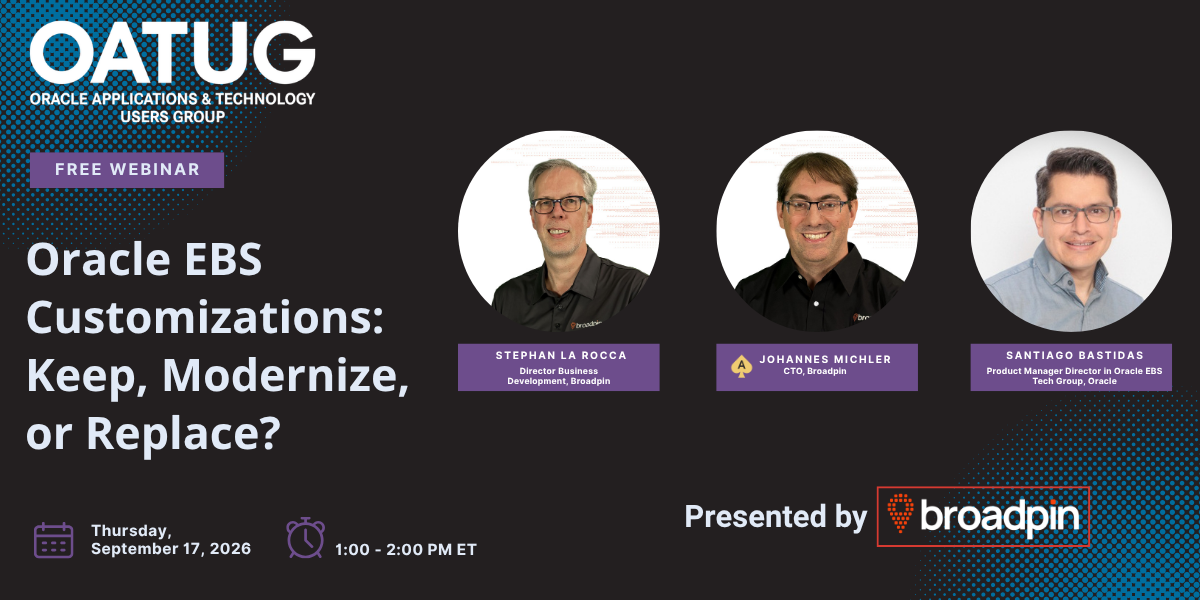
Oracle EBS Customizations: Keep, Modernize, or Replace?
When: Thu, Sep 17, 2026 from 01:00 PM to 02:00 PM (ET) Your local time: Do., 17. Sept. 2026, 19:00 – 20:00 MESZ
Many Oracle E-Business Suite customers rely on customizations to support critical business processes – but do you know exactly what has been customized in your EBS environment, why it is still needed, and whether it is ready for the future?
Join us for an expert discussion featuring Santiago Bastidas, Product Management Director in Oracle’s E-Business Suite Technology Group, and Johannes Michler, CTO at Broadpin and Oracle ACE Director – both with extensive expertise in Oracle EBS, together with Stephan La Rocca, Director, Business Development at Broadpin and a modernization expert. Together, they will share practical perspectives on how to approach the future of EBS customizations.
Explore how to keep, modernize, or replace existing customizations while protecting your investments and keeping your EBS core upgradeable. Learn how to address common challenges such as missing documentation, technical debt, limited transparency, high maintenance costs, and upgrade complexity – and how Oracle APEX, modern web and mobile capabilities, and AI can support a step-by-step modernization strategy.
The session will also introduce a Rapid Insight Assessment as a practical starting point to gain transparency into your customizations and identify the right next steps for your EBS environment.
Running Oracle EBS? Don’t miss this session – and feel free to send us your questions when registering for the webinar.
Presenters: Santiago Bastidas, Product Management Director, Oracle Johannes Michler, CTO, Broadpin, Oracle ACE Director Stephan La Rocca, Director of Business Development, Broadpin
Modernizing legacy Oracle Student Records System into a modern cloud platform
Client’s Detail
Technologies & Use Cases
Modernizing legacy Oracle Student Records System into a modern cloud platform
Client’s Detail
Technologies & Use Cases
Top Outcomes at a Glance
Faster, more reliable university systems for students and staff
New visibility into workflows through process mining
Low-risk modernization path with zero data loss
Proactive, data-driven optimization instead of reactive troubleshooting
Interview with Dr. Arthur Clune CTO at University of Sheffield
Dr. Arthur Clune discusses Sheffield’s modernization journey and the role of PITSS.CON in managing complex Oracle environments.
“PITSS.CON has enabled us to just enable a config switch for more logging and then analyse that later, and then see where our processes get stuck, where our data goes, and use that to then redesign those processes to be more efficient.”
Dr. Arthur Clune CTO, University of Sheffield
Interview with Dr. Arthur Clune CTO at University of Sheffield
Dr. Arthur Clune discusses Sheffield’s modernization journey and the role of PITSS.CON in managing complex Oracle environments.
“PITSS.CON has enabled us to just enable a config switch for more logging and then analyse that later, and then see where our processes get stuck, where our data goes, and use that to then redesign those processes to be more efficient.”
Dr. Arthur Clune CTO, University of Sheffield
The Challenge
Two decades of legacy infrastructure struggling to support modern academic operations
The University of Sheffield, a leading research-intensive institution in Northern England with approximately 35,000 students specializing in science, engineering, and medicine, found itself at a technological crossroads. At the heart of its academic operations sat a mission-critical student record system built on Oracle Forms—a system that had faithfully served the university for nearly 20 years.
This core system managed the complete student lifecycle: from initial applications and admissions through year-to-year progression, exam tracking, results management, graduation, and post-graduation records. While functionally sound and operationally stable, the system had become increasingly complex and outdated over time.
Key Challenges Identified:
> Legacy Oracle and Forms versions running on outdated infrastructure
> Period of underinvestment had left the system “a little bit behind the times”
> Aging on-premise hardware limiting reliability and performance
> Growing complexity making maintenance increasingly difficult
> Limited ability to support future innovation and modernization
Despite these challenges, the system remained operational and critical to the university’s daily operations. CTO Dr. Arthur Clune characterized it as “very large, very complex, but it works”—a testament to its robustness even as modernization became increasingly necessary.
The Challenge
Two decades of legacy infrastructure struggling to support modern academic operations
The University of Sheffield, a leading research-intensive institution in Northern England with approximately 35,000 students specializing in science, engineering, and medicine, found itself at a technological crossroads. At the heart of its academic operations sat a mission-critical student record system built on Oracle Forms—a system that had faithfully served the university for nearly 20 years.
This core system managed the complete student lifecycle: from initial applications and admissions through year-to-year progression, exam tracking, results management, graduation, and post-graduation records. While functionally sound and operationally stable, the system had become increasingly complex and outdated over time.
Key Challenges Identified:
> Legacy Oracle and Forms versions running on outdated infrastructure
> Period of underinvestment had left the system “a little bit behind the times”
> Aging on-premise hardware limiting reliability and performance
> Growing complexity making maintenance increasingly difficult
> Limited ability to support future innovation and modernization
Despite these challenges, the system remained operational and critical to the university’s daily operations. CTO Dr. Arthur Clune characterized it as “very large, very complex, but it works”—a testament to its robustness even as modernization became increasingly necessary.
The Solution
A comprehensive modernization strategy leveraging PITSS.CON, AWS cloud, and Oracle APEX
1. Automated Forms Upgrades
>
PITSS.CON’s first major application at Sheffield was streamlining Oracle Forms version migrations. The platform enables structured, automated upgrades that are “quicker, reliable, and easier to scale” across multiple systems. For this project, Sheffield engaged both the PITSS.CON software and the PITSS professional services team, who worked as an extension of their internal team to execute the Forms upgrades.
2. AWS Cloud Migration
>
The university transitioned from aging on-premise hardware to running natively in AWS. This migration encompassed upgrading to the latest Oracle and Forms versions while completely re-architecting the system’s infrastructure. The cloud migration delivered immediate benefits in speed and reliability for end users. More strategically, it provided an opportunity to map out system architecture, redesign integrations, analyze data flows, and establish a foundation for future innovation.
3. Oracle APEX Integration
>
Originally a pure Forms environment, Sheffield’s system evolved to incorporate Oracle APEX and Java components. APEX was introduced specifically to leverage existing PL/SQL business logic while modernizing the user experience—an incremental approach the team describes as “a better user experience while keeping that well-tested, well-used core logic the same.” This strategy allows Sheffield to avoid discarding decades of proven business logic in Forms and the database. Instead, APEX provides a lower-risk upgrade path with improved UX, reusing existing logic that’s been refined over 20 years of operation. The first APEX application deployed was a research grant and costing tool, demonstrating how data flows seamlessly between APEX apps, the database, Forms applications, and Java components.
4. Process Mining & Analytics
>
With such a complex, interconnected system, tracking data and process flows across multiple applications presented significant challenges. PITSS.CON’s process mining capabilities enable Sheffield to trace user journeys across the entire ecosystem—from APEX apps into the database, through Forms applications, potentially to Java apps, and back again. The implementation is elegantly simple: enable tracing via a configuration switch at deployment, then analyze the collected data to identify bottlenecks, unused code, and opportunities for optimization. Dr. Clune notes this is “”key for us to be able to identify high impact areas where we can put the effort in to make the experience better.” Discover Process Mining capabilities
The Solution
A comprehensive modernization strategy leveraging PITSS.CON, AWS cloud, and Oracle APEX
1. Automated Forms Upgrades
>
PITSS.CON’s first major application at Sheffield was streamlining Oracle Forms version migrations. The platform enables structured, automated upgrades that are “quicker, reliable, and easier to scale” across multiple systems. For this project, Sheffield engaged both the PITSS.CON software and the PITSS professional services team, who worked as an extension of their internal team to execute the Forms upgrades.
2. AWS Cloud Migration
>
The university transitioned from aging on-premise hardware to running natively in AWS. This migration encompassed upgrading to the latest Oracle and Forms versions while completely re-architecting the system’s infrastructure. The cloud migration delivered immediate benefits in speed and reliability for end users. More strategically, it provided an opportunity to map out system architecture, redesign integrations, analyze data flows, and establish a foundation for future innovation.
3. Oracle APEX Integration
>
Originally a pure Forms environment, Sheffield’s system evolved to incorporate Oracle APEX and Java components. APEX was introduced specifically to leverage existing PL/SQL business logic while modernizing the user experience—an incremental approach the team describes as “a better user experience while keeping that well-tested, well-used core logic the same.” This strategy allows Sheffield to avoid discarding decades of proven business logic in Forms and the database. Instead, APEX provides a lower-risk upgrade path with improved UX, reusing existing logic that’s been refined over 20 years of operation. The first APEX application deployed was a research grant and costing tool, demonstrating how data flows seamlessly between APEX apps, the database, Forms applications, and Java components.
4. Process Mining & Analytics
>
With such a complex, interconnected system, tracking data and process flows across multiple applications presented significant challenges. PITSS.CON’s process mining capabilities enable Sheffield to trace user journeys across the entire ecosystem—from APEX apps into the database, through Forms applications, potentially to Java apps, and back again. The implementation is elegantly simple: enable tracing via a configuration switch at deployment, then analyze the collected data to identify bottlenecks, unused code, and opportunities for optimization. Dr. Clune notes this is “”key for us to be able to identify high impact areas where we can put the effort in to make the experience better.” Discover Process Mining capabilities
The Results
Measurable performance gains and a sustainable path forward for continuous improvement
Enhanced Performance & Reliability
The migration to AWS delivered immediate, tangible improvements in system speed and reliability for all end users. Moving from aging on-premise hardware to cloud-native infrastructure eliminated performance bottlenecks that had accumulated over years of operation, providing a noticeably better experience for both students and staff.
Operational Intelligence Through Process Mining
Even in the early stages of implementation, process mining has revealed previously invisible workflow inefficiencies. The university can now track complete user journeys across their multi-application environment, identifying where processes become stuck, which code paths are no longer used, and where optimization efforts will have the greatest impact.
This capability transforms system management from reactive troubleshooting to proactive optimization, enabling data-driven decisions about where to invest development resources.
Low-Risk Modernization Path
By integrating Oracle APEX with their existing Forms and PL/SQL infrastructure, Sheffield has established an incremental modernization strategy that doesn’t require discarding two decades of proven business logic. This approach significantly reduces risk compared to a complete system replacement while still delivering modern user experiences.
The university can now modernize components progressively, keeping what works while improving what needs updating—a sustainable strategy for long-term system evolution.
The Results
Measurable performance gains and a sustainable path forward for continuous improvement
Enhanced Performance & Reliability
The migration to AWS delivered immediate, tangible improvements in system speed and reliability for all end users. Moving from aging on-premise hardware to cloud-native infrastructure eliminated performance bottlenecks that had accumulated over years of operation, providing a noticeably better experience for both students and staff.
Operational Intelligence Through Process Mining
Even in the early stages of implementation, process mining has revealed previously invisible workflow inefficiencies. The university can now track complete user journeys across their multi-application environment, identifying where processes become stuck, which code paths are no longer used, and where optimization efforts will have the greatest impact.
This capability transforms system management from reactive troubleshooting to proactive optimization, enabling data-driven decisions about where to invest development resources.
Low-Risk Modernization Path
By integrating Oracle APEX with their existing Forms and PL/SQL infrastructure, Sheffield has established an incremental modernization strategy that doesn’t require discarding two decades of proven business logic. This approach significantly reduces risk compared to a complete system replacement while still delivering modern user experiences.
The university can now modernize components progressively, keeping what works while improving what needs updating—a sustainable strategy for long-term system evolution.
Long-standing Partnership with PITSS
Sheffield’s relationship with PITSS spans 10-15 years, with PITSS.CON becoming integral to managing their evolving Oracle technology stack. The platform has been essential for enabling development velocity and managing the complexity of a system now encompassing Oracle Forms, Oracle APEX, Java components, and extensive PL/SQL code.
According to Dr. Clune, PITSS.CON “helps us tie those things together and understand what’s going on, make upgrades easier” across their diverse technology ecosystem.
Technologies That Powered the Modernization
PITSS.CON
Modernization & Analysis Tools
Automated Oracle Forms analysis
Process mining and data flow tracking
Code cleanup and optimization
Upgrade acceleration
Oracle APEX
Modern Application Platform
Low-code UI framework
Seamless PL/SQL integration
Runs alongside Oracle Forms
Modern user experience
AWS Cloud
Cloud Infrastructure
Improved performance
Enhanced scalability
Superior reliability
Future-ready architecture
Explore additional case studies to gain further insights
Unlocking AI Enablement by Migrating Oracle Forms to APEX
Online / June 16, 2026 · 12 pm EDT
→ With Jason Haynes, APEX Software Architect, Oracle
Overview
What this webinar is about
Many enterprises are still running stable and business‑critical Oracle Forms applications. While these systems continue to perform reliably, organizations are increasingly challenged when it comes to innovation and AI adoption. Integrating modern AI capabilities—such as chatbots, AI agents, or LLM‑based analytics—directly into Oracle Forms applications is often not feasible. As a result, companies frequently consider rebuilding applications from scratch, facing higher costs, increased complexity, and fragmented system landscapes.
In this webinar, we present a pragmatic and low‑risk alternative.
By combining Oracle OCI AI Services with Oracle APEX as the native web application platform on OCI, organizations can enable AI capabilities step by step, without disrupting their existing Oracle Forms environments. Instead of a costly big‑bang modernization, a proven side‑by‑side approach allows AI functionality to be introduced alongside existing applications, focusing on concrete use cases that deliver fast, measurable business value.
Participants will learn how Oracle Forms applications can be analyzed and structured into functional clusters, how relevant AI use cases can be identified, and how selected components can be incrementally extended or rebuilt in Oracle APEX. This approach not only stabilizes ongoing operations but also generates valuable insights that support and accelerate modernization initiatives such as Forms2APEX from day one.
The webinar clearly demonstrates that getting started with AI does not have to be a large‑scale transformation project. Instead, organizations can adopt AI in a focused, incremental, and value‑driven way—fully aligned with Oracle’s strategic direction.
Agenda highlights
What we’ll cover
Legacy application challenges and modernization drivers
Oracle OCI and AI capabilities
Step‑by‑step modernization from Oracle Forms to APEXs
Practical AI enablement for existing Oracle Forms applications
Free · 60 min Save your seat
Speakers
Your experts for this session
Stephan La Rocca Business Development Manager, PITSS
Stephan has been helping companies to bring their Forms applications to the next level and maximize profit for over 20 years. He can be seen presenting innovative solutions for Oracle applications at events such as the DOAG (German Oracle Users Group) Conference.
Kelly Genovich Operations Manager, PITSS America LLC
Kelly Genovich shows operational excellence which results in cost savings, increased efficiency, and improved customer satisfaction. She has a deep understanding of PITSS customers' situations and can provide them with the best possible advice.
Ready to learn more about modernization?
Explore our comprehensive solutions and use cases to see how we can help transform your Oracle infrastructure.
Solutions Explore our Customized Optimization and Modernization of Oracle applications. From Forms to APEX, Reports to Jaspersoft, we provide end-to-end migration strategies.
Use Cases Discover real-world success stories and practical applications of our modernization tools. See how organizations across industries have successfully transformed their Oracle infrastructure.
Answer two short questions and secure your chance to win an exclusive Oracle Racing jacket, T-shirt or cap.
Closes May 20, 2026 · 5:00 PM /
About the Giveaway
What this is about
Limited time
Visit Broadpin (formerly PITSS) at APEX connect and DOAG Cloud Database + Infrastructure. Share two quick insights about your APEX and database environment, and you’re automatically entered to win exclusive Oracle Racing merchandise.
Participation is free and takes less than a minute. Winners are drawn after the event.
The Prize
Exclusive Oracle Racing merchandise
Oracle Racing jacket, T-shirt or cap
Awarded by random draw among all eligible entrants
• Draw closes May 20, 2026• Notification by email• Shipped to winners
How it Works
Three steps to enter
1
Scan or open the entry form
Find us on-site or use the QR code from the Broadpin flyer.
2
Answer two short questions
Tell us which event you’re attending and your biggest APEX/database challenge.
3
You’re in the draw
Winners are notified by email after the event. Respond within 7 days to claim your prize.
Why participate
Beyond the prize
✓
Share what’s really blocking your APEX & database teams today.
✓
Help shape topics Broadpin brings to the next APEX connect / DOAG.
✓
Get on the list for follow-up insights tailored to your environment.
✓
Take home exclusive Oracle Racing merch if your name is drawn.
The fine print
Terms & Conditions
Full version
1
Organizer
The organizer of the competition is PROMATIS software GmbH — Part of the Broadpin group (ITG BV).
2
Participation requirements
Participation is free. Adult visitors of the APEX connect & DOAG Cloud Database + Infrastructure event are eligible. Entry is completed by submitting the short survey via the QR code on the flyer.
3
Participation period
The competition runs exclusively during the event and ends on May 20, 2026 at 5:00 PM.
4
Prizes
Oracle Racing clothing (subject to availability: jacket / T-shirt / cap) will be raffled off among all participants. Cash payment, transfer, or exchange of the prize is excluded.
5
Determining & notifying the winner
Winners will be notified by email after the event. If a winner does not respond within 7 days, the prize will be redrawn.
6
Data protection
Only the data necessary for conducting the prize draw (name, email address) is collected. It is used only for processing the draw and is then deleted. Further information: www.promatis.com/de/datenschutz/.
7
Grounds for exclusion
The organizer reserves the right to exclude participants in cases of manipulation, false information, or violations of these conditions.
8
Disclaimer
Legal recourse is excluded. The organizer accepts no liability for technical malfunctions (e.g., in the transmission of participation).
9
Severability clause
Should individual provisions be invalid, the validity of the remaining terms and conditions of participation shall remain unaffected.
Legacy Modernization Oracle Forms Oracle APEX Digital Transformation
Ask, Learn, Connect: Your Q&A Hub for PITSS,
Oracle APEX, and Oracle Forms Modernization
In many Oracle APEX and application modernization projects, recurring questions often arise:
Which architecture is most suitable? How can processes be modernized efficiently? What challenges occur in real-world implementations?
In many Oracle APEX and application modernization projects, recurring questions often arise:
Which architecture is most suitable? How can processes be modernized efficiently? What challenges occur in real-world implementations?
To address these questions in a structured way, the PITSS.CON Q&A APP was developed. The application serves as a central platform where users can post questions, share answers, and exchange experiences related to APEX and modernization projects.
The app is also a prime example of how Oracle APEX can be used to quickly build modern, web-based business applications that are accessible on any device and simplify access to complex data and processes.
Who is the PITSS.CON Q&A APP for?
The PITSS.CON Q&A APP is designed for anyone involved with Oracle Forms/Reports, APEX, legacy applications, application modernization, process optimization, application transparency, or enterprise systems.
IT Decision-Makers
CIOs, IT managers, and architects can gain insight into typical challenges in modernization projects and see what questions other organizations are asking.
Developers and APEX Specialists
APEX developers can use the platform to discuss technical questions, share best practices, and learn new approaches.
Companies with Legacy Systems
Organizations looking to modernize existing applications – such as Oracle Forms systems – can discover common challenges and practical solutions.
Project Teams in Modernization Initiatives
Teams actively migrating or upgrading systems benefit from a structured repository of relevant questions and answers.
What the PITSS.CON Q&A APP offers?
The PITSS.CON Q&A APP provides a simple and intuitive way to gather and exchange knowledge.
Centralized Question Collection
Users can post questions about APEX, modernization, or architecture.
Structured Answers
Other participants or experts can answer, contributing their insights and experiences.
Knowledge Platform for Modernization Projects
Over time, the app builds a growing repository of typical challenges and proven solutions.
Web-Based Access
As an APEX application, it runs directly in the browser and is fully responsive – no local installation required.
What the PITSS.CON Q&A APP Can Do for You?
The PITSS.CON Q&A APP delivers multiple advantages for companies and developers alike:
Knowledge Sharing
The platform encourages the exchange of experiences and best practices between experts and users.
Faster Problem Solving
Existing answers and discussions help teams resolve common challenges more quickly.
Insight Into Frequent Challenges
Organizations can immediately see which issues are common across the industry – for example, during migration to APEX.
Community-Driven Approach
The app creates a collaborative environment where knowledge is continuously expanded and refined.
Showcases Modern APEX Applications
At the same time, it demonstrates how Oracle APEX can be used to develop modern web apps that are responsive, secure, and database-driven.
Conclusion
The PITSS.CON Q&A APP is more than just a Q&A platform. It serves as a central hub for anyone involved with Oracle APEX and application modernization.
By combining knowledge sharing, real-world experience, and modern web technology, the app helps organizations understand challenges faster and implement solutions more efficiently.
From PITSS to Broadpin – New Name. Broader Vision.
Stuttgart / Ettlingen / Bergen op Zoom (NL) / Madrid (ES) / Half Moon Bay (US) – 25.03.2026 – Transformation doesn’t end at go-live. And neither do we. After more than 25 years of successful company history, PITSS is opening a new chapter: PITSS becomes Broadpin. With our long-standing experience and unique expertise in modernizing Oracle enterprise applications, we have decided to position our portfolio more clearly and strengthen the presence of our solutions in the market.
Broadpin brings together 4 strong Oracle partners under one roof: Quistor, Project Partners, Promatis, and PITSS. Broadpin integrates decades of expertise across the entire Oracle ecosystem. No matter which Oracle challenge you are tackling, you will find your solution with us – and Broadpin is exactly where you need us: Global Reach – Local Expertise.
Under the Broadpin brand, we are combining our capabilities and expanding our proven modernization approach. In the future, we will support companies not only in transforming Oracle Forms, but also in modernizing a wide range of Oracle technologies and existing applications. Our goal is clear: to support you sustainably modernize your established IT landscapes, accelerate innovation, and make your systems future-ready – with tools, with methodology, with expertise, and with success.
You remain our highly valued customer!
With the switch to Broadpin, you may be wondering what this change means for you. Let us clarify that.
What stays the same?
The people you trust, the expertise you rely on, and the commitment to your success.
What’s new?
A more effective structure, expanded capabilities, and a stronger global framework that enables us to deliver consistent support, while staying close to your local needs.
Do you have any questions for us? Feel free to schedule an appointment with your preferred PITSS contact person or send us your inquiry here.
Legacy Modernization Oracle Forms Enterprise IT Digital Transformation
Why Modernizing Legacy Applications
is Business-Critical
Many core applications were built when business models were far less dynamic. Today they create high risks and block strategy. Modernization is not an IT project — it’s a strategic lever.
PITSS Editorial Team
·
March 2, 2026
·
8 min read
Why Renewing Legacy Applications is Business-Critical
Many of our core applications were built at a time when business models, processes, and customer requirements were far less dynamic. Today, these systems generate high operational risks, prevent scaling, and hold back strategic initiatives. Modernization is therefore not primarily an IT project — it is a strategic business lever.
◎ The Core Argument
Modernizing legacy applications is not an optional IT upgrade — it’s a strategic business enabler to increase efficiency, reduce risks, and position the company for the future.
1 Accelerating Innovation & Time-to-Market
Monolithic legacy applications make changes extremely difficult. New features, digital services, or process changes can only be implemented with enormous effort.
❯
Modern, modular architectures enable rapid responses to market demands — shipping new features in days instead of months.
2 Higher Data Quality & Better Decision-Making
Legacy systems create data silos and make analytics and AI-based evaluations difficult or impossible.
❯
A modern data foundation enables better customer insights, faster decisions, and unlocks the potential of AI-driven automation.
3 Improved User & Customer Experience
Outdated interfaces reduce productivity and customer satisfaction, driving up training costs and leading to widespread workarounds.
❯
New applications increase efficiency, adoption, and service quality — and give employees tools they actually want to use.
4 Reducing Operational Risks & Maintenance Costs
Legacy systems are built on outdated technologies and specialized knowledge that is increasingly hard to find. Outages or security vulnerabilities can immediately impact business operations. Furthermore, many business processes are still held up by manual workarounds or poorly integrated third-party systems — commonly known as Shadow IT.
⚠ Hidden Risk
Shadow IT — undocumented manual workarounds and ad-hoc integrations — can silently undermine compliance, data integrity, and business continuity. Modernization brings these into the light.
❯
Modernization increases stability, supportability, and compliance. Through automation, cloud readiness, and modern platforms, long-term costs decrease significantly.
5 Future-Proof Scalability
Growth or new business models hit hard technical limits in old systems. Every expansion becomes an engineering struggle rather than a business opportunity.
❯
Modern applications scale on demand and support international expansion without architectural rewrites.
How to Successfully Modernize a Legacy Application?
The key tool is the Process–Application Fit Matrix. It helps assess how well a legacy application supports your current business processes along two dimensions.
Dimension 1
Business Value
How important is this process to the business?
Dimension 2
Application Fit
How well does the legacy system support this process?
The Basic Process–Application Fit Matrix
Application Fit ↓ / Business Value →
High Business Value
Low Business Value
Good Fit
✓ Stable & Worth Keeping
Non-critical — can stay
Weak Fit
⚡ Strategic Modernization Need
Opportunistic Modernization
Evaluation Criteria
▲ Business Value
Process is business-critical
Process generates revenue
Regulation or compliance-relevant
Strongly customer-facing
Differentiates from competitors
◆ Application Fit
Functional coverage
Stability & Performance
Changeability (Time-to-Change)
Integration capability (APIs)
Security & Compliance
Usability & automation level
💡 An Important Addition
In highly grown applications, a third value appears in practice: “Obsolete” for Business Value, and “Non-existent” for Application Fit. Obsolete processes are still in the code but no longer lived. Non-existent fit means the digital capability simply doesn’t exist yet and must be built from scratch.
The Extended Matrix (Recommended)
Business Value / App Fit →
Obsolete
Medium
High
High
Remove
“Reskinning” — homogeneous architecture
Focus on Maintainability, Enhancement & Performance
Medium
Remove
Can standard software take over?
Find the diamonds — create a Redesign
Non-existent
—
Can standard software take over?
New development with deep data model integration
Real-World Examples
Application Fit can address different components within the same software. Click each example to explore the diagnosis and goal:
“Order entry works fairly well, but the user experience is poor.”❯
The data model and implemented logic — such as validations and calculations — are correct. However, it is difficult for users to efficiently handle the standard case.
❯ Data model and business logic are solid, but the interface is the bottleneck.
◎ Goal: Lean User Interface and significantly better User Experience.
“Goods outbounding is inefficient, even though it is easy to use.”❯
The UI works fine and all data is available, but the algorithm calculating the outbounding is error-prone, outdated, and must be reworked.
❯ UI fits, data fits — the business logic itself is the problem.
◎ Goal: Revision and optimization of the Business Logic.
“In goods receiving, customer RMA assignments are missing.”❯
UI and logic for goods receiving are fine. Goods are received and stored, but the data model is missing the automated assignment to the customer’s goods announcement.
❯ UI and logic are sound — the data model must be extended.
◎ Goal: Anchor the assignment in the data model and implement it in the application layer.
How PITSS.CON ProFind Makes This Possible
In monolithic legacy applications, mapping software artifacts to an individual business process is not always easy — or even possible. The examples above show that the assessment can relate to different components simultaneously, and it is sufficiently complex to check how everything connects across the entire application.
You can only trust the code and the way users actually interact with it.
PITSS.CON is a software repository that examines and consolidates the implementation of the legacy application with its actual runtime usage by users, batch processes, and interfaces.
PITSS has been awarded twice by the BMBF for its unique approach of connecting static code with live runtime data.
Defined target processes can be efficiently captured and compared against actual usage patterns — step by step generating the valuable input your Process-Application Fit Matrix needs. Once assessed, PITSS.CON helps identify all artifacts belonging to each matrix segment and prepares them for modernization.
✔ The PITSS.CON Promise
All of this — covering the data model, business logic, and every individual UI — without lengthy interviews, endless manual documentation, source code misinterpretation, or unnecessary burden on your business users.
With PITSS.CON, you can modernize your legacy application in a step-by-step, risk-free, cost- and benefit-optimized project — guided at every stage by the real picture of how your system is used.
Ready to assess your legacy application?
Let PITSS.CON ProFind map your codebase, usage patterns, and business processes — and build your modernization roadmap based on facts.
Oracle APEXOracle FormsModernization SurveyEnterprise IT
Why Integration Is the Biggest Challenge in Oracle Forms Modernization
Live poll results from our webinar “APEX at Scale: Your Blueprint for Modernizing Oracle Forms” — featuring insights from Simon Hunt, Head of Product Management at Oracle APEX.
PITSS Editorial Team March 13, 2026 7 min read
Valuable Insights from the Webinar
Modernizing Oracle Forms applications and moving them to Oracle APEX raises many strategic and technical questions — but which challenges are organizations actually facing in practice?
To explore this, we asked the participants of our recent webinar “APEX at Scale: Your Blueprint for Modernizing Oracle Forms” about their biggest hurdles and priorities. The session featured insights from Simon Hunt, Head of Product Management – Oracle APEX, who shared valuable perspectives on modernization strategies and the evolution of APEX.
Survey Scale
With more than 200 registrations, these poll results provide a statistically meaningful snapshot of the challenges enterprises are currently navigating in Oracle Forms to APEX modernization projects.
Integration: The #1 Challenge in Enterprise APEX Adoption
As enterprises deploy an increasing number of specialized applications to support diverse tasks and business processes, integration has emerged as the top concern for IT teams.
POLL 1 OF 2
Integration: The #1 Challenge in Enterprise APEX Adoption
As enterprises deploy an increasing number of specialized applications to support diverse tasks and business processes, integration has emerged as the top concern for IT teams.
◆Integrations
48%
Library concepts
38%
Performance
33%
Security
31%
Large developer teams
30%
None
14%
Others
8%
This highlights a growing need to ensure that all components of an organization’s software ecosystem can communicate seamlessly — and that modernization is seen as an ecosystem-wide undertaking, not just an application swap.
Why Integration Matters: The API-First Gap
In many organically grown system landscapes, an API-first strategy is often missing. Interfaces and services have evolved in a fragmented and inconsistent manner — each application a silo unto itself.
Modernization offers a unique opportunity to realign the entire architecture around communication patterns and data flows — building a foundation for robust, maintainable, and scalable applications.
From a technology standpoint, Oracle APEX provides a comprehensive toolset for integration. It allows developers to efficiently consume REST services and expose new REST endpoints. At the same time, the full power of the Oracle Database ecosystem — including Oracle Integration Cloud — remains fully accessible. With APEX delivering a pure HTML5/CSS/JavaScript interface, UI-level integrations can leverage modern web standards.
PITSS.CON’s Role in the Integration Journey
During the modernization of legacy Oracle Forms applications, PITSS.CON plays a critical role. It ensures that essential artifacts — such as complex business logic or data provisioning components — can be exposed as RESTful API services.
PITSS.CON’s end-to-end dependency management across applications lays the groundwork for a consistent and maintainable API catalog — helping enterprises streamline integrations and improve overall system coherence.
Twice awarded by the BMBF for its unique approach of connecting static code with live runtime data.
The Bigger Picture
Modernizing enterprise applications isn’t just about updating technology — it’s about redefining how applications interact, ensuring data flows smoothly, and empowering businesses to fully leverage their software ecosystem. Integration is not just an option — it’s a necessity.
Poll 2: The Two Biggest Obstacles in Forms → APEX
The survey results clearly highlight two obstacles that stand above the rest when organizations move their Oracle Forms applications to Oracle APEX.
POLL 2 OF 2
The Two Biggest Obstacles in Forms → APEX
The survey results clearly highlight two obstacles that stand above the rest when organizations move their Oracle Forms applications to Oracle APEX.
◆How to avoid 1:1 migration
43%
How to improve UX
33%
◆Transaction handling
30%
Function Keys
28%
Enter-Query Mode
22%
Client-Access
16%
Others
12%
These two findings reflect the core complexity of modernization projects: organizations are not simply looking for a technical migration path, but for a way to rethink how their applications work in a modern architecture.
43% Avoiding the 1:1 Migration Trap
The most frequently mentioned challenge is avoiding a 1:1 migration. Replicating an existing Oracle Forms application exactly as it is in APEX may seem like the fastest approach — but this strategy often reproduces the same limitations that already exist in the legacy system.
Instead of taking advantage of modern capabilities, organizations risk transferring outdated user interfaces, overloaded screens, and inefficient process flows directly into a new technology stack.
The Classic Dilemma
Organizations face a choice between a “quick and dirty” migration on one side and an exhausting full rewrite on the other. Fortunately, there is a pragmatic middle path — and the poll results show that teams are actively seeking it.
Organizations can preserve their investment in application components that still deliver value — while selectively renewing the parts that are outdated or no longer aligned with modern requirements.
30% Transaction Handling in a Modern Architecture
The second most significant challenge is transaction handling. Oracle Forms applications often manage transactions in ways that are tightly coupled to the application runtime and its stateful interaction model.
When moving to a modern web-based environment like APEX, these mechanisms must be reconsidered. Transaction logic, commit strategies, and process flows may need to be redesigned so that they fit into a more flexible and scalable architecture.
This does not necessarily mean rewriting everything from scratch. In many cases, the underlying business logic and database structures remain technically sound and are worth reusing.
Not Everything in Legacy Applications Is Obsolete
Legacy applications are often perceived as outdated as a whole. However, a closer look typically reveals a more nuanced picture.
Even in older systems, certain elements remain technically solid and continue to deliver value — while other areas clearly require rethinking:
Often worth keeping
Database structures
Core business logic
Proven validation rules
Needs rethinking
Process support may be inefficient
User interfaces are often overloaded
The overall user experience rarely meets modern expectations
Even within the UI layer
Not everything in the UI needs to be discarded. Many validations, messages, and labels still make sense and can be reused instead of being recreated from scratch — reducing both risk and project duration.
A Process-Driven Modernization Approach
To navigate this complexity, organizations need transparency into their existing systems. With its dependency analysis and code quality assessment capabilities, PITSS.CON helps identify which components of an existing application can be effectively reused in a new APEX environment.
This approach enables a clear, process-driven modernization strategy:
01
Analyze
Examine the existing system to understand dependencies and code quality across the full application.
02
Identify
Pinpoint which components in the database and business logic can be effectively reused in a new APEX environment.
03
Focus
Direct modernization efforts exclusively on the areas that genuinely require improvement or replacement.
04
Align
Redesign the application around actual business processes — not around the monolithic structure of the legacy system.
Modernization is not just about replacing the UI with an APEX interface. While redesigning the user experience is the most visible change, the real value lies deeper. By combining reuse of stable components with selective renewal, organizations can:
Reshape the APEX user interface
Improve process support
Modernize application architecture
Avoid reimplementing every rule and piece of logic
The Core Insight
This ensures that modernization happens alongside business processes — rather than being constrained by the monolithic structure of the legacy system.
Conclusion: Reuse, Renewal, and the Right Balance
Migrating to APEX should not be treated as a simple technology replacement. The real challenge — and opportunity — lies in finding the right balance between reuse and renewal.
By analyzing existing applications carefully and focusing modernization on the components that matter most, organizations can transform their legacy systems into modern, process-oriented solutions — without losing the value built over years of development.
Webinar Available On-Demand
Want the full insights?
If you missed the live session, you can still request the webinar recording and explore the full discussion — including Simon Hunt’s perspective on APEX modernization strategy.
When Graphs Are Not Enough: Interaction Between APEX and Cytoscape
Ljubljana, Slovenia / Friday, April 17, 2026 · 5:35 pm – 6:20 pm CET · Room C
Overview
What is this event about:
Join us to learn how Broadpin helps modernize Oracle Forms applications to Oracle APEX using proven tools, methods, and success strategies. Discover how modern application development with Oracle APEX and innovative technologies works in practice, with real use cases, live demos, and best practices.
Take the opportunity to connect with our experts, exchange ideas, and gain valuable insights for your next projects
Key Outcomes
What you’ll walk away with
Understanding of how to modernize Oracle Forms to Oracle APEX step-by-step.
Practical insights on using Cytoscape with APEX for advanced graph interactions.
Live demo takeaways for applying Broadpin’s migration tools and methods.
Answers to your concerns,open questions, and technical requirements.
Stephan La Rocca Business Development Manager, PITSS
Stephan has been helping companies to bring their Forms applications to the next level and maximize profit for over 20 years. He can be seen presenting innovative solutions for Oracle applications at events such as the DOAG (German Oracle Users Group) Conference.


 Top Outcomes at a Glance


 The Challenge
 The Solution

 The Results