
Author: pitss

PITSS.CON Release 23.3.1 with an outlook

PITSS.CON Release 23.3.1
with an outlook

Just in time for Advent, PITSS delivers
the first gift – PITSS.CON Release 23.3.1.

In this blog article, we take a detailed look at the outstanding functions of the latest PITSS.CON version as well as the PITSS ‘ “development laboratory”, where the seamless work on the in-house product range continues.

Highlights of PITSS.CON Release 23.3.1

  1. Simplified integration through automatic parsing and loading of modules

    With this release, the integration of PITSS.CON is easier than ever before. Automatic parsing and loading of modules enable a seamless connection and speeds up the workflow for developers significantly.
  2. Code refactoring (BL2DB) for the migration from Oracle Forms to Oracle APEX
  3. Another focus is on simplifying the migration from Oracle Forms to Oracle APEX. Enhancements in the area of code invoicing (BL2DB) effectively support developers in making a smooth transition.

  4. New “ProFind” module – process detection and documentation of highest quality
  5. The brand new “ProFind” module sets standards in process documentation. It enables detailed recording of all objects, object components, processes and dependencies down to the smallest detail to ensure optimal preparation for modernization projects.

  6. Supports the latest Oracle Forms version 12.2.1.19
  7. The new PITSS.CON version supports the latest Oracle Forms version 12.2.1.19 to ensure that developers can benefit from the latest features and a smooth integration.

  8. Certification on the Oracle Autonomous Database
  9. Release 23.3.1 brings a certification on the Oracle Autonomous Database with it. This underlines the high quality and security of PITSS.CON in the modern database landscape.

  10. Improvements in the generation of APEX applications
  11. The generation of APEX applications has been further optimized to enable developers to work more efficiently and precisely.

  12. Supports the latest Oracle APEX version 23.2
  13. PITSS.CON remains compatible with the latest technologies. Support of Oracle APEX version 23.2 is a clear signal for the innovative capability of the PITSS product.

  14. Extension in project management for Forms2APEX projects
  15. The project management for Forms2APEX projects has been extended to give developers even more control and overview of their projects.

    As a PITSS.CON customer, you can now arrange your individual PITSS.CON New Release Session with your team and one of our experts. Let us show you the new features and how you can benefit from them with your application.

A look into the future: Visionary developments with PITSS.CON

PITSS.CON’s developments are continuously ongoing and a look into the future promises exciting innovations

  1. Pattern and handwriting recognition of developers

    PITSS product developers continue to work on increasing the level of meaningful generation in APEX. This is to be achieved by recognizing patterns and the handwriting of each developer using pattern recognition.

    Possible hurdles and errors in APEX are to be recognized automatically and provided with context help to ensure a smooth development process.
  2. Further development of ProFind through machine learning and AI
  3. ProFind takes itself to a new level by integrating machine learning and artificial intelligence. It will not only analyze tables, but also recognize concepts and layers (bottom-up) to enable a deep understanding of applications.

  4. APEX Project Eye Integration
  5. The integration of APEX Project Eye (APE) will enable comprehensive visualization and monitoring of APEX projects to further optimize the development process. The perfect complement to the ProFind module.

  6. ProcMAPE – Monitoring, analysis, planning and execution
  7. The strategic goal of ProcMAPE development is the implementation of an automated solution approach for monitoring and analysing ongoing processes as well as the planning and system execution of necessary process and code adaptations. Self-learning (implementing self-learning algorithms), self-adopting (adaptation of software to user behaviour) and software development (continuous software development towards more adaptable systems) are components of this development.


Modernization

Why and how to modernize legacy applications efficiently

Read more


Sponsorship project

PITSS is awarded a BMBF funding project for digital software documentation
Read more

Your Contact

Uta Daniels
Assistant of Sales Management

udaniels@pitss.com
+49 711/914-012-12


Continue reading

[WEBINAR] Revitalize your Oracle Forms!

[WEBINAR] Revitalize your
Oracle Forms!

Keeping your Applications alive and thriving

June 26, 2024 | 4:00 p.m. (CEST)

Regain control and enhance your application


Join us for an insightful 60-minute webinar focused on the importance of maintaining and modernizing Oracle Forms, emphasizing the strategic benefits for your business-critical applications.

FAQs about an Oracle Forms to APEX modernization
This session will guide you through the essential process of regaining control over your Oracle Forms applications, ensuring you can understand, manage, and enhance your existing systems to meet current and future business needs.

Look forward to these topics:

  1. Understanding the importance of Regaining control
    • Why regaining control is crucial for Oracle Forms-based applications with a long development historyl
    • The value of your intellectual property embedded in powerful business logicl
    • Strategies for understanding code and dependencies across applications and databasesl
  2. Comprehensive documentation for better management
    • The significance of maintaining proper and valid documentation
    • How thorough documentation supports effective application management and business support
    • Techniques for ensuring documentation is up-to-date and reflective of current requirements
  3. Modernization approaches and strategic benefits
    • Overview of Oracle’s recommendations for Oracle Forms users: staying current while considering your business and technical needs
    • Analyzing the impact of regaining control on the performance and reliability of your applications
    • Integrating new functions such as mobile enhancements to meet evolving business requirements
  4. The News Oracle Forms Release 14.1.2:
    • Eagerly awaited and planned for 2024
    • Numerous new features and UI improvements
  5. Q&A session
    • An opportunity to ask questions and gain insights from our experts

    What you get from the webinar:

    • Gain a clear understanding of the importance of regaining control over your Oracle Forms applications
    • Learn how to document and manage your applications effectively
    • Network with peers and industry experts to share knowledge and best practices.

    Who should attend:

    • IT Managers
    • Software Engineer Leaders
    • Application Developers
    • Anyone involved in managing or maintaining Oracle Forms applications

REGISTER NOW FOR THE WEBINAR RECORDING:

Revitalize your Oracle Forms!


Quelle  
Lead Source
Lead Status  


Your Speakers

  • Michael Ferrante

    Senior Principal Product Manager at Oracle

    Joining Oracle in 1999, Michael has spent two decades in various roles associated with Oracle Forms and related Fusion Middleware technologies. Working side-by-side with Oracle's customers and Oracle's Development and many Support teams, Michael helps to bring the latest innovations to future versions of Oracle Forms and other Application Development technologies.


  • Sacha Sander

    Global Sales, PITSS

    Sacha Sander has been on board since PITSS was founded. He fills the position of Senior Vice President of Global Sales. His customers appreciate him as a competent source of ideas and reliable partner in choosing the right solutions in software modernization.

  • Stephan La Rocca

    Senior Consultant at PITSS

    At PITSS since 2012, Stephan has managed numerous Oracle Forms modernization projects. He shows customers new ways in the modernization of software. His motto: there is always a solution that helps us move forward!


Continue reading

New Forms2APEX Modeler Release 24.1.1

New Forms2APEX Modeler
Release 24.1.1

06.05.2024 Stuttgart/Troy – The new Forms2APEX Modeler 24.1.1 is available and it is one thing above all – even more efficient than its predecessor. It has succeeded in automating even more tasks in an Oracle Forms to APEX modernization project. This increase in efficiency and further improvements to the software are the result of current modernization projects in which the Forms2APEX Modeler has already impressed customers and project teams with enormous time savings and high-quality results.

The new and improved functions of Forms2APEX Modeler 24.1.1 at a glance
Preparation of the PL/SQL code for transfer to the database

A central aspect of a successful Forms to APEX modernization is the transfer of valuable software artifacts (PL/SQL code) from Oracle Forms to the database in order to make the code available for the new APEX application. In the new version of the Forms2APEX Modeler, there are more options for transferring PL/SQL code to the database. This means that significantly more objects (e.g. PRE and POST-QUERY triggers) can now be transferred and at the same time adapted to individual requirements. This means that code can be added automatically if required (e.g. for additional logging and additional error handling), but the complete structure of the database packages (user interface driven or table API based) can also be decided. This safeguards investments in existing validations, transaction logic and implemented business processes.

Oracle Forms dependencies are made easily visible

The interactive, visual representation of the Oracle Forms structure also makes it easy for developers who do not have in-depth knowledge of Oracle Forms to familiarize themselves with the existing sources within a modernization.

Validations of Forms generated automatically in APEX

Depending on the selection of the APEX region to be created and the field and record validations found in Oracle Forms, validations, dynamic actions and alerts are automatically generated in APEX. In Oracle Forms applications, the validation triggers are the most frequently used triggers alongside the command areas, which means that this generation can save a great deal of time and ensure that validations are not “forgotten” or incorrectly applied.

Selection of regions is supported

When transferring Oracle Forms blocks to APEX regions, the new Forms2APEX Modeler release gives developers more options for the master-detail use of regions. For example, the new Modeler helps with the selection of regions with context-related information.

Ingenious project view for management and developers

In release 24.1.1 of the Forms2APEX Modeler, a completely new and revised checklist has been developed for the remaining work after importing the generated sources. The dashboard shows project managers the status of the current modernization project at a glance, including the next modules to be completed, the current activities of the developers and the progress of the migrated modules. For the developers, the checklist is a safe and convenient tool to ensure that nothing is overlooked in the remaining work. The context-sensitive display of objects, properties and code makes the use of the Forms Builders almost superfluous.


Better than the APEX Page Wizard

Based on the settings of the blocks in the Oracle Forms application, the new Forms2APEX Modeler creates master-detail relations, buttons for the DML operations and the properties of the region depending on the choice of APEX region types. The created region therefore has the same properties and the same behavior as in the original Oracle Forms application and saves research and rework if the region was created via the Page Wizard. The properties for DML row processing and all column properties, such as formatting, alignment, width etc., are of course also adopted.

More flexible in all aspects: multi-scheme capable

If the Oracle Forms application accesses data from different schemas, be it in block attributes or in the definition of value lists, this information is also transferred identically to the APEX application. This means that objects from other schemas can also be accessed regardless of the parsing schema set.

Automated transfer of all leading texts and labels

For both the form-based and the tabular display, all leading texts and column headings are taken identically from the Oracle Forms layout. This means that if you have made an investment in naming the fields for the user in the past, this investment will be retained. If your application dates back to a time before the use of “Prompts” in Oracle Forms, you can use a graphical wizard to automatically assign the texts from the layout of your application to the fields. Incidentally, this step is essential for efficient internationalization of your application.

Offline database support now possible

It is no longer necessary for the PITSS.CON installation to be installed in the same network as the application database. All necessary data can be exported via an export of the schema definitions (PITSS provides an AGENT on the website: https://pitss.com/download-dbagent/). This decoupling makes it possible, for example, to run the Forms2APEX Modeler as SaaS in the cloud without having to worry about network access. This makes it even easier to start modernizing your Oracle Forms application.

Better and easier user experience

The layout of Forms2APEX Modeler 24.1.1 has been adapted and tidied up, taking into account the current work steps in a modernization. An additional process description page provides the user with further information for carrying out the necessary steps. The release supports the latest Oracle Forms (12.2.1.19), APEX (23.2) and database versions (21c). A release for the current long-term release of the database (23c) is still pending.

The benefits of the new Forms2APEX Modeler 24.1.1

One of the biggest achievements of the new version is the ability to generate APEX fragments. This makes modernization projects significantly faster, more efficient, clearer and error-free. PITSS.CON already scores highly in the following areas:

  • Analysis: By looking at every property and every line of code, all important questions are put on the table before the project starts and any surprises during the project are avoided.
  • Documentation: From the entire Forms application landscape, which visualizes all navigation options between the Forms modules, to the graphical representation of all tables within a Forms module or the call-stack behind a button, all dependencies within the application can be documented.
  • Preparation: Cleaning up technical debt (unused code, redundancies and moving PL/SQL code to the database) has long been a guarantee for efficient modernization and creates a perfectly maintainable application.

With the improved generation of APEX code fragments, it is now possible to develop the new APEX application much faster than it is already possible with the various wizards in APEX. The transfer of pages from the generated templates, for example, ensures that all attributes and validations from Forms are already transferred compared to the page wizards. This not only saves important time, but also prevents a requirement from being overlooked or incorrectly “typed”. This allows developers to concentrate on the essentials: Bringing the added value of APEX into their own application.

With the new release Forms2APEX Modeler 24.1.1, the areas “Fragment Generation” and “Create Management Tasks” from the established and successful “PITSS Modernization Process” have been improved. The goal of simplifying and controlling the application redesign and offering the development team more support while retaining all the degrees of freedom available in APEX has been achieved. The release simplifies the entry into modernization and invites you to start with a first cluster.

Would you like to get to know

the new Forms2APEX Modeler?

Please feel free to make an appointment with us:

Your Contact

Uta Daniels
Assistant of Sales Management

udaniels@pitss.com

+49 711/914-012-12


Continue reading

REVIEW OF THE WEBINAR “TOP CHALLENGES IN AN ORACLE FORMS TO APEX MODERNIZATION”

Review of the webinar “Top
challenges in an Oracle Forms
to APEX modernization”

The overwhelming response, with over 180 registrations, underlines the significant interest in this crucial topic. A special thanks goes to Mónica Godoy, Senior Principal Product Manager APEX at Oracle, who enriched the discussion enormously with her great knowledge.

Stuttgart 03/25/2024 – On March 13, 2024, the modernization expert PITSS hosted the live webinar “Top challenges in an Oracle Forms to APEX modernization”. Developers, Programmers, System Architects, Project and IT Managers from all over the world were invited.

In the webinar, the experts provided answers to the most frequently asked questions about Forms to APEX projects in a panel discussion. The most important questions were collected before and during the webinar. The audience took the opportunity to ask their questions. From technology decisions and project planning to the transformation and possibilities of the new APEX application, everything got covered.

An important point of discussion for all Project Managers was Business Logic to Database and its immense importance within a modernization as well as best practices from real world modernization projects.

The numerous advantages of modernization according to Oracle APEX presented by the panel were then able to motivate even the last doubters to face the topic with enthusiasm and confidence. After all, modernization, redesign, simplification, more functionalities and possibilities, no limitations for mobile devices and less complexity in the application are just some of the weighty arguments for the transformation to APEX.

If you want to watch the entire webinar you can request the recording here.

Continue reading

Why and how to modernize legacy applications efficiently

Why and how to modernize
legacy applications efficiently

Outdated legacy applications are the greatest threats to companies’ productivity and revenue. The traditional incremental approach to migrating and modernizing legacy applications is costly and inefficient and often taking years. With PITSS, it’s completely different.

As leaders in digital transformation, we migrate and modernize business-critical legacy systems in a fraction of the time it takes to do so manually.

What sets us apart are our PITSS Products in particular our Application Data Cube (ADC). The Application Data Cube analyzes software without overlooking a single line of code within the shortest time. It allows you to identify and isolate obsolete UIs, business logic, and databases then replace them with updated constructs.

Get inspired by the importance and simplicity of software modernization in 90 seconds.

POPULAR POSTS


Modernization

Why and how to modernize legacy applications efficiently

Read more


Sponsorship project

PITSS is awarded a BMBF funding project for digital software documentation
Read more

Your Contact

Uta Daniels Assistant
of Sales Management

udaniels@pitss.com

+49 711/914-012-12


Continue reading

[WEBINAR] Top challenges in an Oracle Forms to APEX modernization

[WEBINAR] Top challenges in
an Oracle Forms to APEX
modernization

How to overcome them – a panel discussion

March 13, 2024 | 9:00 a.m. (EDT)

THERE ARE MANY CHALLENGES IN AN ORACLE FORMS TO APEX MODERNIZATION PROJECT

What are the biggest challenges in an Oracle Forms to APEX migration? How do you overcome them? A live panel discussion with Oracle APEX experts Mónica Godoy & Stephan La Rocca.

FAQs about an Oracle Forms to APEX modernization
We discuss your and other frequently asked questions about a Forms to APEX modernization. Why replace Forms? Why from Forms to APEX? What is the best way to move from Forms to APEX? How time-consuming is the migration? Feel free to send us your questions while registering for the webinar.

BL2DB – Business logic to database
APEX stands for database-centric development. This makes development much more efficient. So bring the business logic into the database. Benefit from database-centered development with access via browser and a business logic that is available in the database ready for retrieval.

Oracle compliant on track to APEX

Gain first-hand knowledge on how PITSS solutions align with Oracle’s approach to modernization. Discover how PITSS leverages its expertise to ensure full compliance and efficiency throughout the modernization process.

Successful project examples Forms to APEX

Get insights from successful migration projects in order to find the right start for your migration project.

What you get from the webinar:

  • Reason why APEX is the Forms successor technology
  • Answers to all the questions about Oracle Forms to APEX
  • Managing BL2DB – Business Logic to Database
  • Oracle compliant migration solutions
  • Project examples

REGISTER NOW FOR THE WEBINAR RECORDING:

Top challenges in an Oracle Forms to APEX modernization


Quelle  
Lead Source
Lead Status  


Your Speakers

  • Mónica Godoy

    Principal Product Manager – Oracle APEX at Oracle

    Mónica is a leader in the Oracle APEX Community. She is not only an APEX technology expert, but is also passionate about helping companies migrate from Oracle Forms to Oracle APEX. In addition, she is strongly committed to Oracle APEX in Latin America.


  • Uta Daniels

    Sales and Partner networks, PITSS

    Uta is a Sales and Partner networks specialist at PITSS. She is passionate about networking and enabling customers with PITSS solutions.

  • Stephan La Rocca

    Senior Consultant at PITSS

    At PITSS since 2012, Stephan has managed numerous Oracle Forms modernization projects. He shows customers new ways in the modernization of software. His motto: there is always a solution that helps us move forward!


Continue reading

Dynamically get the value selected for autocomplete in Oracle APEX

Dynamically get the value selected
for autocomplete in Oracle APEX

Sometimes we would like to return the selected values from autocomplete and continue to use them in another Javascript function or send the value to the server. This is where Oracle APEX Autocomplete comes in handy.

Oracle APEX Autocomplete is a mechanism commonly used in modern websites to provide the user with a list of suggested words that they have typed in a text box. The user can then select an item from the list displayed in the input field. This feature saves the user from having to type an entire word or a series of words. In this article, you will learn how to dynamically retrieve the selected value for autocomplete in Oracle APEX.

Create a Oracle dynamic action

  • Name: getselectedValue
  • Event: select
  • Item(s): choose your autocomplete Page Item
  • Event Scope: static
  • Action: Execute Javascript Code
  • Code: console.log(apex.item(this.triggeringElement.id).getValue())
  • Fire on Initialization : No

Das neue PITSS.CON Release für Oracle Forms 14c

Der leichte Weg für den Upgrade und die Optimierung von Oracle Forms Applikationen

Mehr lesen


Förderprojekt BMBF

PITSS erhält Zuschlag für Förderprojekt des BMBF zur digitalen Softwaredokumentation

Mehr lesen

Your Contact

Uta Daniels
Assistant of Sales Management

udaniels@pitss.com
+49 711/914-012-12


Continue reading

BMBF funding project Team ProcMAPE meets for status and innovation report in Stuttgart

BMBF funding project Team
ProcMAPE meets for status
and innovation report in Stuttgart

On February 22, 2024, scientists from Ulm University and
PITSS discussed the status and possibilities of “Data-driven
adaptations of process-oriented software systems through
monitoring, analysis, planning and implementation”

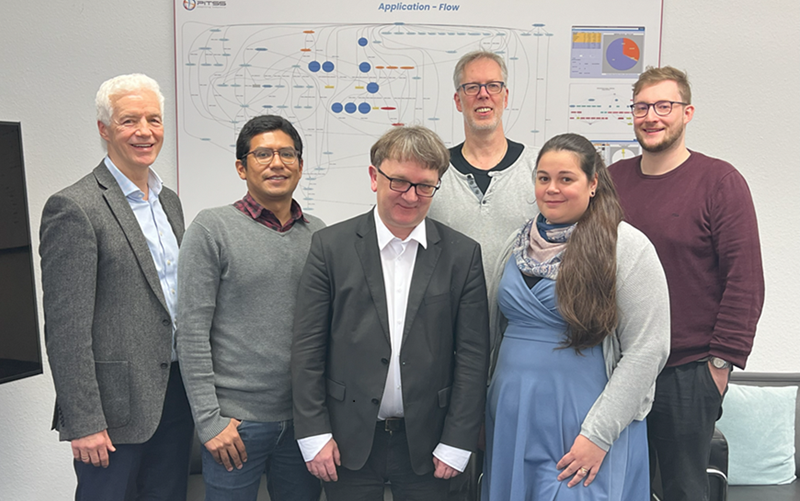
f.l.t.r.: Andreas Gaede (CEO PITSS), Edher Diaz (PITSS), Prof. Manfred Reichert (Head of Institute Databases and Information Systems (DBIS), University Ulm), Stephan La Rocca (PITSS), Lisa Arnold, Marius Breitmayer (both University Ulm).

Stuttgart 02/28/2024 – On February 22, 2024, PITSS, one of the leading modernization experts for Oracle applications, hosted a meeting of the project partners of ProcMAPE (Data-driven adaptations of process-oriented software systems through monitoring, analysis, planning and implementation). Professor Manfred Reichert from the Institute for Databases and Information Systems (DBIS) at the University of Ulm and two of his team members discussed the BMBF-funded project in detail with the PITSS experts.

The innovative ProcMAPE project, funded by the Ministry of Education and Research (BMBF), involves the development of a MAPE (Monitor, Analyze, Plan and Execute) framework for the data-driven adaptation of object-centric processes in software systems. Prof. Manfred Reichert and his two research assistants Lisa Arnold and Marius Breitmayer, as well as PITSS project manager Stephan La Rocca and his colleague Edher Diaz, were involved in the exchange on the project.

The aim of the “ProcMAPE” project is to enable (partially) autonomous, data-driven adaptations of object-centered processes in software systems.

The expert panel discussed the current project status, further project requirements and ideas for achieving the objectives and the possibility of working with LLM and AI in future projects. Project manager Stephan La Rocca was very satisfied with the project status: “We are already recording all interactions with a system for monitoring, from the user interface to the database transaction. In the next step, we will focus on the possibilities of AI for analyzing the recorded events.” All project participants agreed on the importance of personal exchange, even in such highly innovative projects.

Further information on the ProcMAPE project:

Stephan La Rocca

ProcMAPE Projektleiter
E-Mail: slarocca@pitss.com


POPULAR POSTS


Modernization

Why and how to modernize legacy applications efficiently

Read more


Sponsorship project

PITSS is awarded a BMBF funding project for digital software documentation

Read more

Individual consulting for the

modernization of your software

Ask without obligation

Your Contact

Uta Daniels
Assistant of Sales Management

udaniels@pitss.com

+49 711/914-012-12


Continue reading

Requirement specifications for migration projects

Requirement specifications
for migration projects

Migration projects smell different.

Start reading the blog from Joy Baetty (Vice President Seilevel) titled “Gathering requirements for Migration Projects” I could only nod chapter by chapter: „The requirements gathering effort for migration projects is notably different … “ and the differences are “ … scope definition, understanding original business needs, working with end users, discovering the end-to-end functionality and IT involvement.“

That’s exactly what we figured out in over 100 migration projects in the past. More than that, most customers are experienced in maintaining and enhancing the existing software landscape, even developing new software is captured well, but a huge migration project is not the daily business for them. It requires more than you think.

All starts with the scope definition. In short terms, the first reaction is: „All the same, but better“.

In most cases, the underlying business processes won’t change in a dramatic way

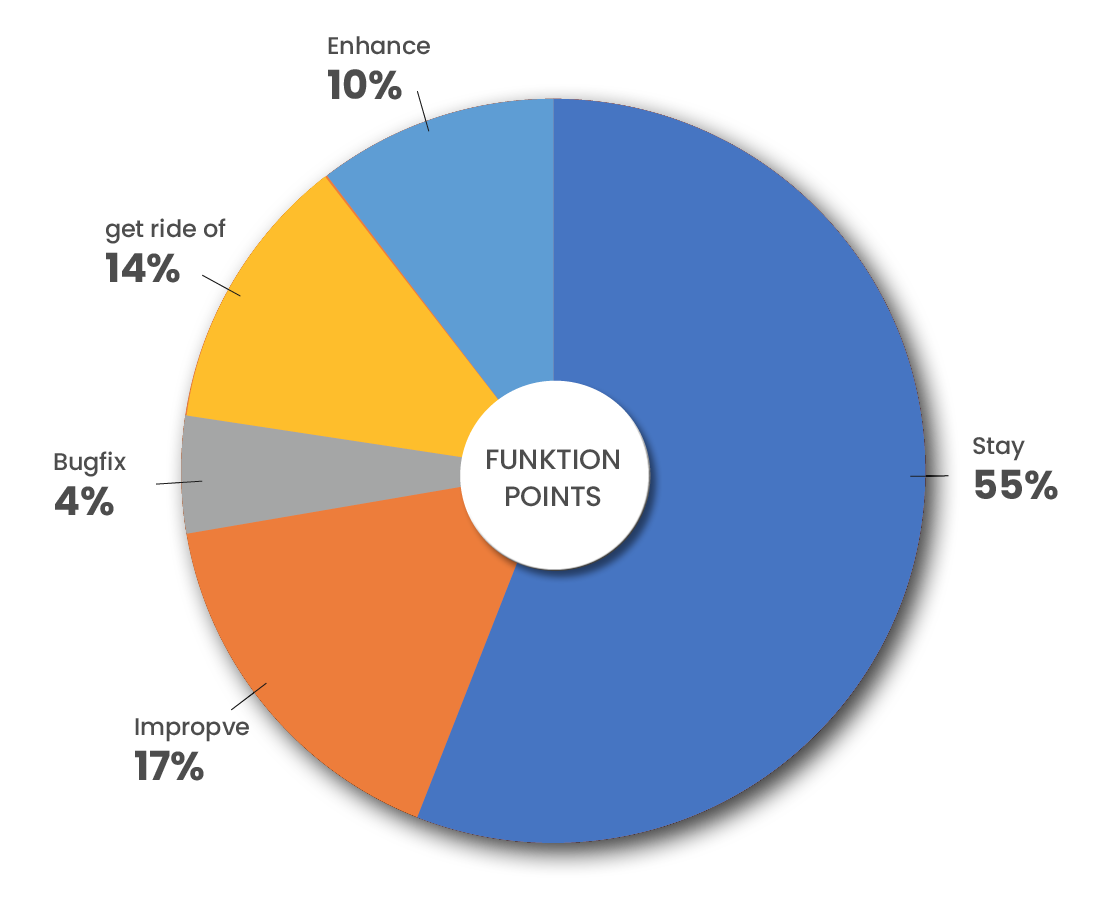
PITSS 2021© Standard ratio of requirement specifications for migration projects

PITSS 2021© Standard ratio of requirement specifications for migration projects
If we consider the amount of Function Points for supporting the various business processes in an existing application, we see such a typical distribution. The sectors treat only the business process, not the user interface, or the underlying implementation. In other words, in an average migration project you improve 17% of your business processes, create 10% totally new, get rid of 14% and correct the behaviour of 4%. More than half will remain the same as before. Once more, not from UX or technology standpoint.

Consequences for the Requirement Specification?

The Key-User is happy to describe in detail the enhancements, he’s keen to point you directly to the bugs, he beliefs to have a complete understanding of the improvements, he’s insecure about the things we could ignore and he doesn’t even have a clue, of the completeness of the things which should stay the same. With classical requirement specification you will cover in best case 31% of the business processes.

If you try to cover the rest, you rely either on existing specification in an actual version of the system – or you have to run into endless interviews with the user to understand the business needs. And you’re not sure if this fits to the actual implementation. So a second iteration of endless code reading follows.

Midsize applications could expand very fast to million lines of code, distributed over different levels of layers (Backend, Midtier, User Interface, Integration Layer, etc.) and we have to consider, that over the years of maintaining, the application is not free of technical debt, which increases the level of complexity.

How to improve 69% of the requirement specification?

Key to success is to combine the required user actions for a business process with the underlying software components. If we could associate each line of code with the order of execution to one or more business processes, we could assign the implementation, the components, more or less all of the software to the business requirements. If there is no association found, the specific part of the application could not be assigned to a business process, we could get rid of it.

How to achieve this association?

We all know the concepts of cookies on web pages, which allow us to analyze user behaviour. Usually legacy applications are not designed to deal with cookies, but with intelligent software parsers it is possible to integrate the concept of the cookies in an existing application without breaking the existing functionalities.

Cookies don’t use a high sophisticated logic, even some minor context information is necessary, to reconstruct the user behaviour. The only manifest is to insert the cookie into each procedure, user interaction object, class, etc. A perfect match for a software parser and a modern IDE.

How does this change the requirement specification?

There are two different approaches that help to get a full picture of the application in a very smooth, fast and absolutely accurate way.

On one hand the user is able to track a single but complete business process, giving a dedicated start and endpoint. The order and level of cookies describe immediately the assigned user interface, all validations, business logic and persistent functionalities. An excellent start of a retrograt business process specification. With additional annotation, the user is allowed to give feedback to existing bugs, possible improvements or any other soft facts to the process.

Do not only talk about – do it, record it, understand it. #SimplifyingComplexity

On the other hand you could observe the application from an overall perspective. Let the user run day by day through the application and let the cookies record their stories. After a while you will identify the hot spots in the application, but also white spaces with no traffic. This allows you to point the user directly to these parts of the application and ask him to record the missing business process or clarify this functionality (and by the way you could perfectly describe this through the knowledge of the missing cookies).

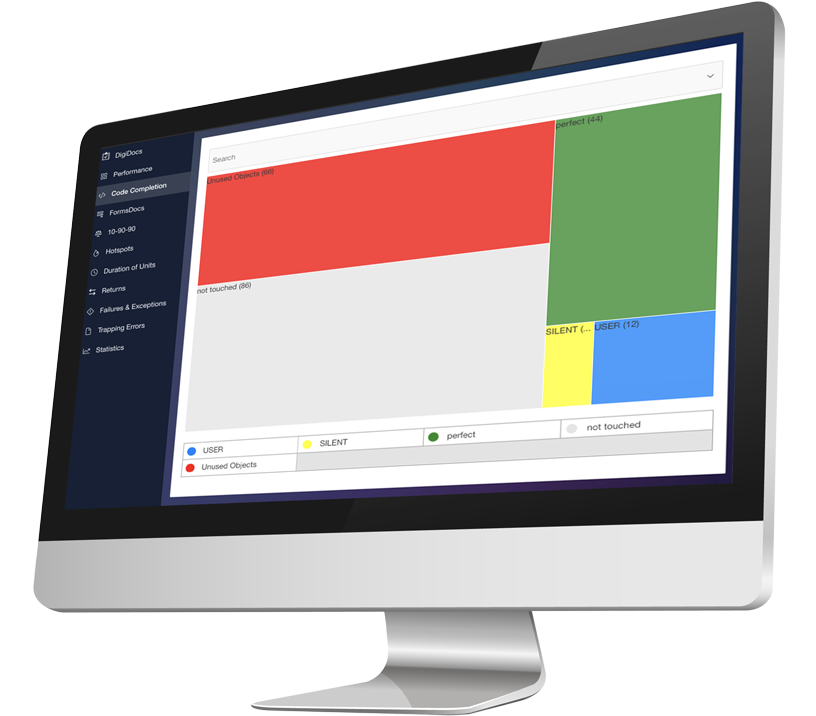
With the concepts of cookies in place, you could divide the implementation into five buckets

PITSS 2021© Dashboard of “DigiDocs” after a couple of recordings.

PITSS 2021© Dashboard of “DigiDocs” after a couple of recordings.

POPULAR POSTS


Modernization

Why and how to modernize legacy applications efficiently

Read more


Sponsorship project

PITSS is awarded a BMBF funding project for digital software documentation

Read more

Your Contact

Uta Daniels Assistant
of Sales Management

udaniels@pitss.com

+49 711/914-012-12


Continue reading

How to Choose the Right Source Code Analysis Tool

How to Choose the
Right Source Code
Analysis Tool

Source code analysis (or static analysis) software helps identify buggy code. Wouldn’t it be cheaper to write secure code in the first place? For a lot of enterprises, their legacy software has accrued years of technical debt, so the enterprise was unable to write secure and pristine code along the way.

One of the fastest growing areas in the software security industry is source code analysis tools, also known as static analysis tools. These tools review source code line by line to detect security vulnerabilities and provide advice on how to remediate problems they find – ideally before the code goes into production.

The entire software security market was worth about $300 million in 2007. It’s estimated that the tools portion of that market doubled from 2006 to 2007 to about $180 million. About half of that is attributable to static analysis tools, which amounted to about $91.9 million.

And no wonder; according to Gartner, Inc., close to 90% of software attacks are aimed at the application layer. If security were integrated earlier in the software development lifecycle, flaws would be uncovered earlier, reducing costs and increasing efficiency compared with removing defects later through patches or never finding them at all. Although there is no replacement for security-aware design and a methodical approach to creating more secure applications, code-scanning tools are a very useful addition to the process.

Despite the high degree of awareness, many companies are behind the curve in their use of static analysis tools, possibly due to the big process changes that these tools entail.


Key Decisions in Source Code Analysis

1 Should you start with static tools or dynamic tools or use both?

In addition to static analysis, which reviews code before it goes live, there are also dynamic analysis tools, which conduct automated scans of production Web applications to unearth vulnerabilities. In other words, dynamic tools test from the outside in, while static tools test from the inside out.

Many organizations start with dynamic testing, just to get a quick assessment of where their applications stand. In some cases, the groups that start this initiative are in security or audit compliance departments and don’t have access to source code. The natural second step is to follow up with static analyzers, enabling developers to fix the problems found by dynamic analysis tools. Some companies continue using both, because each type yields different findings.

2 Do you have the source code?

Most static analyzers scan source code, but what happens if you want to analyze third-party software or code written so long ago that you only have the executable? In that case you could try a tool that offers binary code scanning through a software as a service platform. A vendor may not be willing to give you source code, but they will give you executables or binary in many cases.


Source Code Analysis Tools: Evaluation Criteria

  • Support for the programming languages you use. Some companies support mobile devices, while others concentrate on enterprise languages like Java, .Net, C, C++ and even Cobol.
  • Good bug-finding performance, using a proof of concept assessment. Hint: Use an older build of code you had issues with and see how well the product catches bugs you had to find manually. Look for both thoroughness and accuracy. Fewer false positives means less manual work.
  • Internal knowledge bases that provide descriptions of vulnerabilities and remediation information. Test for easy access and cross-referencing to discovered findings.
  • Tight integration with your development platforms. Long-term, you’ll likely want developers to incorporate security analysis into their daily routines.
  • A robust finding-suppression mechanism to prevent false positives from reoccurring once you’ve verified them as a non-issue.
  • Ability to easily define additional rules so the tool can enforce internal coding policies.
  • A centralized reporting component if you have a large team of developers and managers who want access to findings, trending and overview reporting.

Do’s and Don’ts of Source Code Analysis

  • Don’t underestimate adoption time required. Most static analysis projects are initiated by security or compliance, not developers, who may not immediately embrace these tools.
  • Do analyze pricing as different vendors have different pricing structures and your enterprise has different needs.
  • Do plan to amend your processes. Tools are no replacement for strong processes that ensure application security from the beginning, starting with defining requirements, which should focus on security as much as functionality.
  • Do retain the human element. While the tools will provide long lists of vulnerabilities, it takes a skilled professional to interpret and prioritize the results.
  • Don’t forget the business case. You’ve got to unite the business and technical sides to ensure everyone is on the same page and that you know what to do with the results.
  • Do consider using more than one tool or a tool that performs a variety of functions that will be critical to analyzing your legacy application.

POPULAR POSTS


Modernization

Why and how to modernize legacy applications efficiently

Read more


Sponsorship project

PITSS is awarded a BMBF funding project for digital software documentation

Read more

Your Contact

Uta Daniels Assistant
of Sales Management

udaniels@pitss.com

+49 711/914-012-12


Continue reading