


Nowadays almost every company has comprehensive IT systems, the majority of which have a long history. Business applications, that have grown over decades, confront decision-makers as well as the IT team with great challenges. What is today modern and future-proof can already be outdated by tomorrow and become an obstructive legacy. One therefore needs the possibility, to be able to appropriately further develop applications – in the sense of sustainable application development.
The modernization experts of PITSS focus their research and development precisely in this field. They revolutionize the application development by building on product-based methods and transferring the values of old applications into a modern IT world. This innovative thinking and acting has now been commended as a BMBF sponsorship project.

Mr. Gaede, with your research project “Soft Proc, Development of methods for the retrograde process analysis from a running application” you will be sponsored by the BMBF. Can you briefly explain to us what it is about?
Software developments or modernization projects fail, are delayed and consume enormous sums of money. One main reason for this is the manageability, which in most cases can be traced back to the lack of documentation of the implemented software. Because only the person who understands and penetrates the software can also meaningfully work with it. Well documented software saves enormous costs, avoids errors and enables easy entry for new colleagues or new development partners.We all know, that in practice applications or requirements are in most cases developed under time constraints, savings are made in the documentation. As soon as the applications have to be adapted or expanded, this sparse documentation is no longer of any help, instead it causes further irritation. As a consequence the costs and times explode, just as the entire project.
That is why, with SoftProc we are developing a new product, that analyses an implemented application with everything that distinguishes it, from program code through to its productive processes, and assembles it into an image that can be understood by everyone. A kind of real-time documentation, which is fed with the latest program versions and with productive data from the running applications. This new knowledge makes decisions possible again and implementations simple and reliable.
And there is nothing like that up to now?
No. There are indeed analysis tools, which deal with source code and code quality, but none of these consider the complete application up to the real processes. That is an absolutely crucial point, because only the knowledge of how the users handle the application specifies how the program code really works. A dependency on former developers no longer exists, one learns and understands the software by using it.A major buzzword of today’s IT is “Process Mining“, where one makes use of the so-called logfiles, in other words log data, in order to interpret a real process. What works well for standard products turns out to be hardly solvable for individual applications. We therefore rely on this new type of approach, which records, analyses and displays all components of an application in an understandable form – SoftProc.
What kind of product will emerge as a result?
In the next two years we will launch products on the market, that analyze applications and present the information acquired in an attractive form – also as Cloud solutions. A main focus of the research thereby is the visualization of the different items of information from the application, oriented to the respective issues of the viewer, such as e.g. code quality, object uses, function chains, sequences, test coverage, data throughputs or performance aspects. These new products will put organizations in the position of being able to quickly and reliably make the right decisions and implement development projects swiftly, targeted and successfully.For which organizations, persons, situations and requirements will this software be developed?
Our software is directed at all organizations and branches that develop their own IT systems. The benefit increases dramatically with the size, in other words the complexity of an application, since large applications are, of course, the most difficult to penetrate.Our products have for many years provided reliable decision-making bases for responsible persons up to CIOs, CTOs, CDOs etc., based on their own systems, without the need for in-depth IT knowledge. The products are also intended for architects and developers, who want to plan information-based and work target-oriented.
In this day and age we are subjected to a high degree of pressure and many influences. Frequently changing market conditions, company strategies, business relations, regulations etc. make fast acquisition and implementation necessary. Or the companies expand, merge, develop new business units and they cast all that in software, couple systems, design interfaces or expand existing ones. This highly dynamic interplay of business and IT processes, always documented up-to-date, creates an optimum of effort and costs with maximum quality.
By which research partners are you accompanied and what role do they play?
For scientific expertise Herr Prof. Dr. Manfred Reichert, Head of the Chair DBIS – Institute for Databases and Information Systems – University of Ulm, provides support. He researches and teaches with his team in the field “Development of Innovative Technologies for Business Process Management”. Prof. Reichert is one of the pioneers in the field of agile Process-Management-Technologies. He has published a variety of publications on this subject, has been distinguished several times and enjoys an international reputation as visionary. His expertise and that of his institute is already available to our customers during the ongoing sponsorship project, in order to have their valuable experience and expectations flow into the development of the product early on.Even at an early age I was fascinated by the representation of analog actions and work sequences in a variety of programming languages. As a mechanical engineer I was also fascinated by the constantly increasing degree of automation, that one had been striving for a long time already in manufacturing and production processes. Thereby, ever since I can remember, the manageability – in the form of documentation – the reusability of process steps as well as simple sequences is at the forefront, because it decisively determines the degree of automation.
Maybe that’s where the motivation came from and the vision, to develop products that have a very high degree of automation, in order to be able to master the tremendously fast transformation in IT with the challenges of digitalization and never ending modernization.
To be sponsored by the federal government is a great distinction. What significance does that have for you and your company?
To be among the Top 50, chosen from over 6000 highly innovative project approaches, naturally makes us proud. But more importantly it is an appreciation for the enormous commitment of all PITSS employees over many years and for our product-based approaches, to optimize software development by means of intelligent automatisms.At this point my very special thanks go to the PITSS Team in the USA, UK and Germany, the companions, families and friends, as well as our many customers in over 40 countries worldwide, who have made this recognition possible. For years we have been able to measure our performance in our projects against IT service providers and software departments, who adhere rigidly to the traditional, personnel- and cost-intensive – but also error-prone – course. Even if here the concern for something new still outweighs the unknown, we notice, that more and more companies are searching for innovative, practicable ways.
The enormous potential that products such as SoftProc can have for the IT in companies, has been recognized by the academic specialist committees and honored with the sponsorship project. Here our thanks go to the Federal Republic of Germany, specifically the BMBF, for the support of our innovative ideas and approaches. That confirms our decision, to expand our Research & Development and the practical testing in the areas of the latest software development.
What significance do research projects such as yours have for our economy?
The thinking in Germany is more reserved and conservative. Experienced, one rests on the laurels of our car manufacturers and mechanical engineers. When it comes to IT, which will inevitably determine our future, after SAP or a unicorn such as Celonis, it gets quite sparse. It would be very sad, if Germany, as the land of poets and philosophers, would oversleep the striving to network everything analog into digital. To pursue innovation means, to promote ideas wherever they occur. For this reason, here our thanks again to the BMBF with its KMU program, that specifically promotes small and medium-sized companies, in which so many ideas and innovations lie dormant.In comparison to the leading IT nations we are still far behind. To change something here requires a change in our mindset, the commitment of every single individual and a far greater perception of social obligations of our large, international corporations, which also evolved from an erstwhile vision. It also requires just as much a greater willingness of banks and investors to invest, to really move something along.
With the SoftProc project, we are consequently pursuing our vision, that man can only successfully manage the enormous, fast growing demand for software in quantity and complexity, when he is supported by intelligent products. To develop just such products is our aim. Because companies as well as our economy will be forced to realize their IT projects far faster and more agile, in order to find their place at the front in a globally digital world.
Entrepreneurs, CIOs, CTOs, CDOs, IT-Managers, Risk-Managers, Administrators and also Developers are now surely listening attentively. When is the software expected to be available? And how and when can one get in touch with you, in order to learn more or also to test the prototypes?
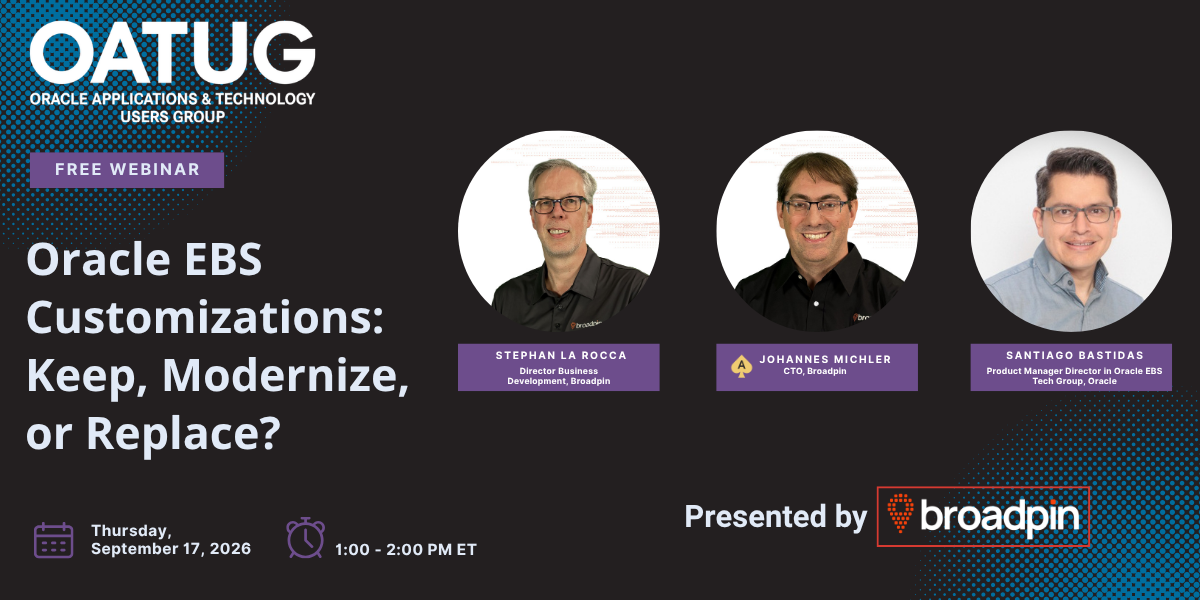
SoftProc will be in progress over the next two years, a product resulting from this is expected at the end of the project. However, this way there will always be product stages for trials and testing. Interested parties as well as sceptics are today invited to contact us, in order to learn more about the subject or to actively accompany the project.Oracle EBS Customizations: Keep, Modernize, or Replace?
When: Thu, Sep 17, 2026 from 01:00 PM to 02:00 PM (ET)
Your local time: Do., 17. Sept. 2026, 19:00 – 20:00 MESZ
Many Oracle E-Business Suite customers rely on customizations to support critical business processes – but do you know exactly what has been customized in your EBS environment, why it is still needed, and whether it is ready for the future?
Join us for an expert discussion featuring Santiago Bastidas, Product Management Director in Oracle’s E-Business Suite Technology Group, and Johannes Michler, CTO at Broadpin and Oracle ACE Director – both with extensive expertise in Oracle EBS, together with Stephan La Rocca, Director, Business Development at Broadpin and a modernization expert. Together, they will share practical perspectives on how to approach the future of EBS customizations.
Explore how to keep, modernize, or replace existing customizations while protecting your investments and keeping your EBS core upgradeable. Learn how to address common challenges such as missing documentation, technical debt, limited transparency, high maintenance costs, and upgrade complexity – and how Oracle APEX, modern web and mobile capabilities, and AI can support a step-by-step modernization strategy.
The session will also introduce a Rapid Insight Assessment as a practical starting point to gain transparency into your customizations and identify the right next steps for your EBS environment.
Running Oracle EBS? Don’t miss this session – and feel free to send us your questions when registering for the webinar.
Presenters:
Santiago Bastidas, Product Management Director, Oracle
Johannes Michler, CTO, Broadpin, Oracle ACE Director
Stephan La Rocca, Director of Business Development, Broadpin
Presented By:
Broadpin
Location
Online Instructions:
Url: https://app.smartsheet.com/b/form/01a043a035c07f0fb2f2b18484c709fb
PITSS is awarded a BMBF funding project for digital software documentation
Read more
Your Contact
Uta Daniels Assistant
of Sales Management
udaniels@pitss.com
+49 711/914-012-12